The quick answer (if you’re in a hurry)
A hand-crank generator can realistically produce 5–30 watts sustained. That’s enough to charge a phone, run a small radio, or top up a power bank over 30–60 minutes of cranking. It is not enough to run a laptop directly, power an inverter, or charge a car battery in any practical timeframe.
Realistic energy from 30 minutes of cranking at 15W: about 7.5 watt-hours — roughly half a phone charge.
| What you want to power | Hand-crank viable? | Realistic time investment |
|---|---|---|
| Phone (via power bank) | Yes, slow but workable | 45–90 min for a partial charge |
| LED headlamp/flashlight | Yes, efficient | 10–20 min for hours of light |
| Small radio | Yes, great fit | 10–15 min for several hours |
| Power bank (10,000 mAh) | Yes, but slow | 3–5 hours for a full charge |
| Laptop directly | No — too little power | Would need 10+ hours |
| 12V car battery | Barely, only as top-up | Impractical for meaningful charge |
| Anything via an inverter | No — losses are too high | Not realistic |
The best use: keep a hand-crank as a backup to solar panels and batteries. When the sun is out, solar does the heavy lifting. When it’s not, hand-crank fills small gaps for critical devices.
Key takeaways
- Most people can sustain roughly 5–30W by hand for meaningful time; spikes higher are possible but tiring.
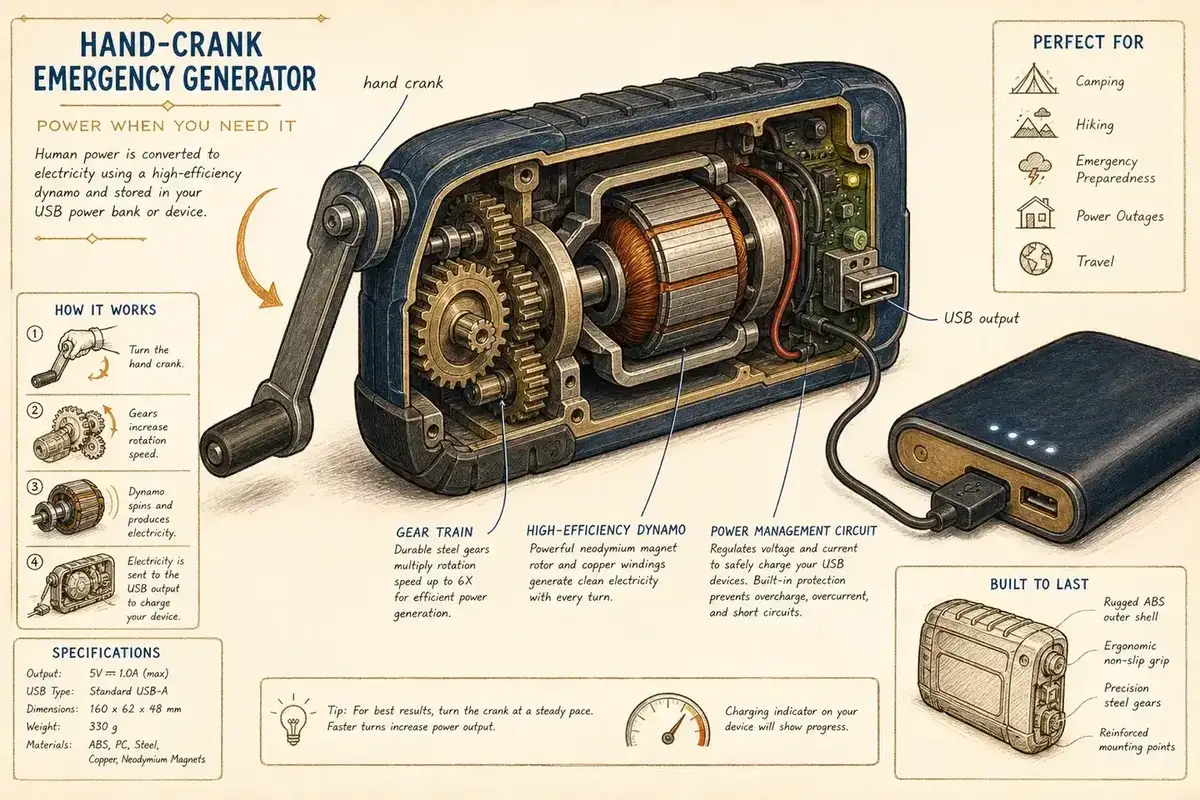
- The safe architecture is: generator → rectifier → regulated DC output → device/battery.
- Directly wiring a hand generator to a battery can cause overvoltage, overheating, and unpredictable current.
- Hand-crank works best for phones, radios, lights, and topping up a small battery bank — not for running high-power loads.
- For dramatically more human-powered energy, pedal power generates 50–150W — your legs are far stronger than your arms.
Beginner explanation: hand power is small, but still useful
Your hands can produce meaningful mechanical power, but not in huge amounts. Think in watt-hours:
- 10W for 30 minutes = 5 Wh (about 1/3 of a phone charge)
- 20W for 30 minutes = 10 Wh (about 2/3 of a phone charge)
- 30W for 30 minutes = 15 Wh (roughly one full phone charge)
For comparison: a single 100W solar panel in average sun produces 400–600 Wh per day — that’s 40–60x more energy than 30 minutes of hand cranking.
Hand-crank is best as an emergency backup and a learning tool. For the same effort, pedal power is dramatically better because legs are stronger and more efficient.
Solar basics (watts vs watt-hours) →
Realistic power and charging expectations
Let’s be specific about what “5–30W” means in terms of actual devices:
Watt-hours: the number that matters
A phone battery holds about 10–15 Wh. A 10,000 mAh power bank stores about 37 Wh. A 12V battery (50Ah) stores about 600 Wh.
Hand-crank output vs what devices need:
| Your effort | Power output | Energy in 30 min | What that fills |
|---|---|---|---|
| Light cranking | 5–10W | 2.5–5 Wh | LED light for 5+ hours |
| Comfortable pace | 10–20W | 5–10 Wh | ~½ phone charge |
| Hard cranking | 20–30W | 10–15 Wh | ~1 phone charge |
| Peak burst (30 sec) | 30–50W | N/A (can’t sustain) | Not useful for energy budgeting |
Key insight: your arms fatigue faster than your battery fills. The limiting factor isn’t the generator — it’s human endurance. Plan for 15-minute sessions with rest breaks.
What can you charge?
- Phones: slow but workable, especially if you charge a power bank first.
- Radios: often low power and a great fit.
- Small LED lights: efficient and predictable loads.
- 12V battery bank: possible for topping up, but do it through a regulated charger and proper protection.
What’s usually unrealistic?
- Running an inverter for AC loads continuously.
- Fast charging big electronics for long periods (laptops can work, but only if the power path is efficient and expectations are modest).
How a hand-crank generator works
Most hand-crank generators are either:
- DC generator (output is DC voltage that rises with speed), or
- AC alternator (output is AC that needs rectification).
Why voltage spikes happen
The faster you crank, the higher the generator voltage tends to rise. If the output is unloaded (nothing connected), voltage can climb surprisingly high. That’s why you want a controlled path that clamps voltage and limits current.
Safe charging architecture (recommended)
A safe, predictable hand-crank system looks like this:
- Generator (DC or AC)
- Rectifier (if needed) to convert AC to DC
- Regulated DC stage to clamp voltage and limit current (buck/boost converter or charger module)
- Output device: USB port, power bank, or battery charger input
Why “regulated DC” matters
Regulation makes the system feel better to use:
- You get predictable output even if crank speed varies.
- Your device sees cleaner voltage.
- It reduces the risk of overheating wires and connectors.
Think of this like a tiny off-grid system: even small sources deserve basic protection and good wiring decisions.
Build options: USB, 12V battery, or power bank
The best output choice depends on what you want to charge and how patient you are.
Option A: charge a power bank (often the easiest)
- Pros: the power bank smooths output; charging is tolerant of small variations.
- Cons: you lose some energy to conversion and the power bank’s own charging circuitry.
Option B: regulated USB output (direct device charging)
- Pros: simple user experience; works for small electronics.
- Cons: devices can be picky about voltage stability; low input power may cause “connect/disconnect” behavior.
Option C: charging a 12V battery (only with proper charge control)
If you want to charge a 12V battery bank, treat it like any off-grid source:
- Use a charger/controller designed to limit current and stop at safe voltage.
- Fuse the positive lead near the battery.
- Use a disconnect so you can safely service the circuit.
Typical parts for a hand-crank charging system
| Component | What it does | Typical price |
|---|---|---|
| DC motor or alternator | The generator itself | $10–40 |
| Bridge rectifier (if AC) | Converts AC to DC | $2–5 |
| Buck/boost converter | Regulates voltage to stable 5V USB | $3–8 |
| USB breakout board | Provides a clean USB output port | $1–3 |
| Power bank (10,000 mAh) | Buffers energy for device charging | $15–25 |
| Inline fuse + holder | Protects the circuit | $2–5 |
Total for a basic system: roughly $30–80 depending on what you already have. The power bank is the single most useful component — it solves the “unstable output” problem that makes direct phone charging frustrating.
Disconnect guide → Fuses vs breakers → Choosing 12V/24V/48V →
Ergonomics, gearing, and “comfortable watts”
Most hand-crank setups fail for a simple reason: they’re unpleasant to use. If the handle is awkward or the resistance changes wildly, you’ll stop using it — which makes the project pointless.
Comfortable cadence beats peak RPM
Your goal is a steady rhythm that you can maintain without strain. If your output system requires you to crank extremely fast to get usable voltage, you’ll fight the tool instead of using it.
Why gearing matters
Gearing trades speed for torque:
- Higher generator RPM can help you reach usable voltage.
- But higher RPM demands higher hand torque when you draw current.
A good design lands in the “boringly repeatable” zone: stable voltage, stable resistance, stable charging behavior.
A practical way to test ergonomics
- Time a 5-minute steady cranking run.
- Log average watts and how your hands/arms feel afterward.
- If you can’t repeat it comfortably, change gearing or regulation before chasing more watts.
A simple emergency energy budget (what to prioritize)
Hand-crank is at its best when you use it intentionally. Instead of trying to “power everything,” pick a few critical needs and keep the energy math simple.
Step 1: list your real emergency loads
- Phone: communication and maps
- Radio: weather and updates
- Light: a small LED headlamp or lantern
- Optional: a small rechargeable battery pack so you can charge when it’s convenient
Step 2: estimate daily watt-hours (rough is fine)
You don’t need perfect numbers. The goal is a “sanity check” that tells you if the plan matches human effort:
- Phone top-up: 5–15 Wh/day (depends on use and signal strength)
- Small radio: 2–8 Wh/day
- LED light: 2–10 Wh/day depending on brightness and hours
If your total is 20–30 Wh/day, and you can sustain ~15W, you’re looking at 1–2 hours of cranking over a day. That’s workable in a pinch — and a good reason to use hand-crank as a backup to solar and batteries.
As another reference point, many common power banks store on the order of tens of watt-hours. That means a single “full power bank” worth of energy can represent a meaningful amount of hand effort. This is why the “charge a power bank first” workflow can be both practical and motivating: you can see progress and budget your time.
Step 3: choose the smoothest workflow
- If direct phone charging is finicky, charge a power bank first, then charge the phone from the bank.
- If you already have a small battery bank in your solar system, a regulated top-up path can be more stable than USB-only wiring.
Wiring and protection (don’t skip this)
Every honest hand-crank plan starts with measured numbers, not advertised ones: crank voltage, current into your actual device, and how both sag as your arms tire. A 600V CAT III meter handles all of it at hobby power (per manufacturer spec). Not for: anything mains-side. The honest tradeoff: continuity mode is the feature you will use most — for tracing which of your connector swaps broke — and any meter does that; this one survives the workbench.
Check price on Amazon (opens in a new tab) Price & availability shown on Amazon.com — we may earn a commission.Hand generators are low power, but that doesn’t mean wiring is optional. Loose connections and thin wires create voltage drop and heat, which makes charging unstable.
- Use the right wire gauge for the current you expect.
- Keep runs short when charging at low voltage (USB especially).
- Add a fuse if you connect to any battery source.
Wire size guide → Fuse sizing guide →
Common mistakes and misconceptions
- Assuming “rated watts” are sustained. Many claims are peak values at uncomfortable crank speeds.
- Direct battery connection. Without regulation, current can be uncontrolled and voltage can spike.
- Trying to power AC loads via an inverter. The conversion chain is long and losses stack up.
- Ignoring ergonomics. A stable mount and comfortable handle often matter more than a “bigger generator.”
How it pairs with solar
A hand-crank generator is best as a “last-mile” backup when solar is unavailable (night, storms, equipment failures). The cleanest pairing is:
- Solar handles the normal charging.
- A small battery stores energy.
- Hand crank tops up small devices if needed.
System sizing guide → Battery charging troubleshooting →
For the solar side of the pairing: solar phone chargers compared → and battery monitoring on a budget →.
Troubleshooting
My phone charges for a moment, then stops
- The device likely isn’t seeing stable voltage/current. Add or improve regulation.
- Try charging a power bank first; it’s often more tolerant than a phone.
- Shorten cables and improve connectors to reduce voltage drop.
The generator gets hot quickly
- You may be drawing too much current continuously. Reduce load or add current limiting.
- Check for mechanical drag (misalignment, rubbing, bearing issues).
- Improve ventilation and treat output as intermittent, not continuous.
Cranking feels “spiky” or resistance changes a lot
- Use a regulated stage that presents a smoother load to the generator.
- Consider a small intermediate battery (power bank) to buffer output.
- If your design uses gearing, verify nothing is slipping under load.
Troubleshooting mindset (symptoms vs causes) →
FAQ
How many watts can a hand-crank generator realistically produce?
Is it better to charge a phone directly or charge a power bank?
Can I charge a car battery with a hand-crank generator?
What’s the best upgrade if I want more human-powered energy?
What other generator sources use similar wiring logic?
Small wind, micro-hydro, and treadmill motors used as generators all benefit from the same idea: rectify if needed, regulate output, and protect wiring.
Related guides:
How long a 100Ah battery actually runs things Battery capacity calculator