Key takeaways Quick answer What each device is good at The five places people get protection wrong A shopping checklist (ratings to verify) Common mistakes FAQ
Key takeaways
- Fuses and breakers both provide overcurrent protection, but they’re not interchangeable in every DC application.
- The best “upgrade” is often better placement and correct DC ratings, not more devices.
- Battery-to-inverter protection is commonly the highest priority because currents can be high.
Wiring & protection cost (big picture) Solar fuse and breaker sizing (planning guide)
Quick answer (for most small systems)
Short answer: use fuses for one-shot source protection at the cheapest point — a string fuse at the combiner or a terminal fuse at the battery, sized to the wire it guards. Use a DC-rated breaker where you want to reset without replacing hardware and where one device doubling as a disconnect saves an extra box: battery-to-inverter mains, controller-to-battery, and DC load panels. Either way, DC voltage and interrupt ratings are the non-negotiable spec — an AC-only breaker on a DC circuit can fail to interrupt.
Think of it this way: the reader is the hero trying to keep a system safe and serviceable. The “guide” (this site) gives you a simple plan: protect the high-current paths, add safe isolation points, and verify DC ratings.
- Use fuses where you want simple, fast protection and you’re fine replacing the device after it trips.
- Use DC-rated breakers where resettable protection (and sometimes switching) is useful.
- Use disconnects for safe service isolation (disconnects are not automatically overcurrent protection).
How to read this page: this is a planning guide, not a test report — we test nothing on this site. The rules and multipliers below trace to the National Electrical Code’s PV sections, named here so you can verify: NEC 690.8(A) (a PV circuit’s maximum current is the string’s short-circuit current Isc × 125%), NEC 690.8(B) (conductors sized to at least 125% of that current), NEC 690.9(B) (overcurrent protection rated at no less than 125% of maximum current — the basis of the Isc × 1.56 string-fuse rule), NEC 690.11 (DC arc-fault protection above 80 V), and NEC 690.12 (rapid shutdown). Wiring and battery-side circuits follow the general overcurrent rules of NEC 240. Everything here is planning guidance — the datasheet max-fuse ratings printed on your controller, inverter, and panels are hard limits, and your AHJ has the final word on permitted work. The site-wide criteria behind how we recommend products and standards are on our how we recommend page.
Comparison: fuse vs breaker at a glance
| Factor | Fuse | Breaker |
|---|---|---|
| What it does when it trips | Opens permanently — a one-shot weak link; the circuit stays open until the fuse is replaced | Trips to the off position and can be reset after the fault is cleared (a manual reset, and only after the cause is found) |
| Reset vs replace | Replace the element every time it blows (keep spares) | Reset with a flip; no replacement part unless it fails mechanically |
| DC rating criticality | Must be DC-rated at system voltage with a DC interrupt rating that covers the fault current — AC-only fuses don’t clear DC arcs dependably | Same, and the stakes are higher: an AC-only breaker on a DC circuit can fail to interrupt, so verify the DC voltage and DC interrupt rating on the label |
| Where it’s required or best | String fuses at the combiner/array (NEC 690.9); battery terminal fuses within ~150 mm (6–8 in) of the post (marine-practice Class T / MRBF, ABYC E-11); any one-shot, lowest-cost protection point | Battery-to-inverter mains, controller-to-battery, and DC load panels — anywhere a resettable device doubling as a service disconnect earns its place |
| Cost class | A few dollars per element (planning band, not a price — see our wiring & protection cost guide) | Tens of dollars per device, plus enclosure and bus hardware (planning band, not a price — same cost guide) |
| Main risk if misapplied | A fuse sized too large protects nothing — the wire melts first; a nuisance-blown fuse on a circuit that needs reset convenience | Using an AC-only or under-rated DC breaker: it may not interrupt DC fault current, and the breaker becomes the failure point |
What each device is good at
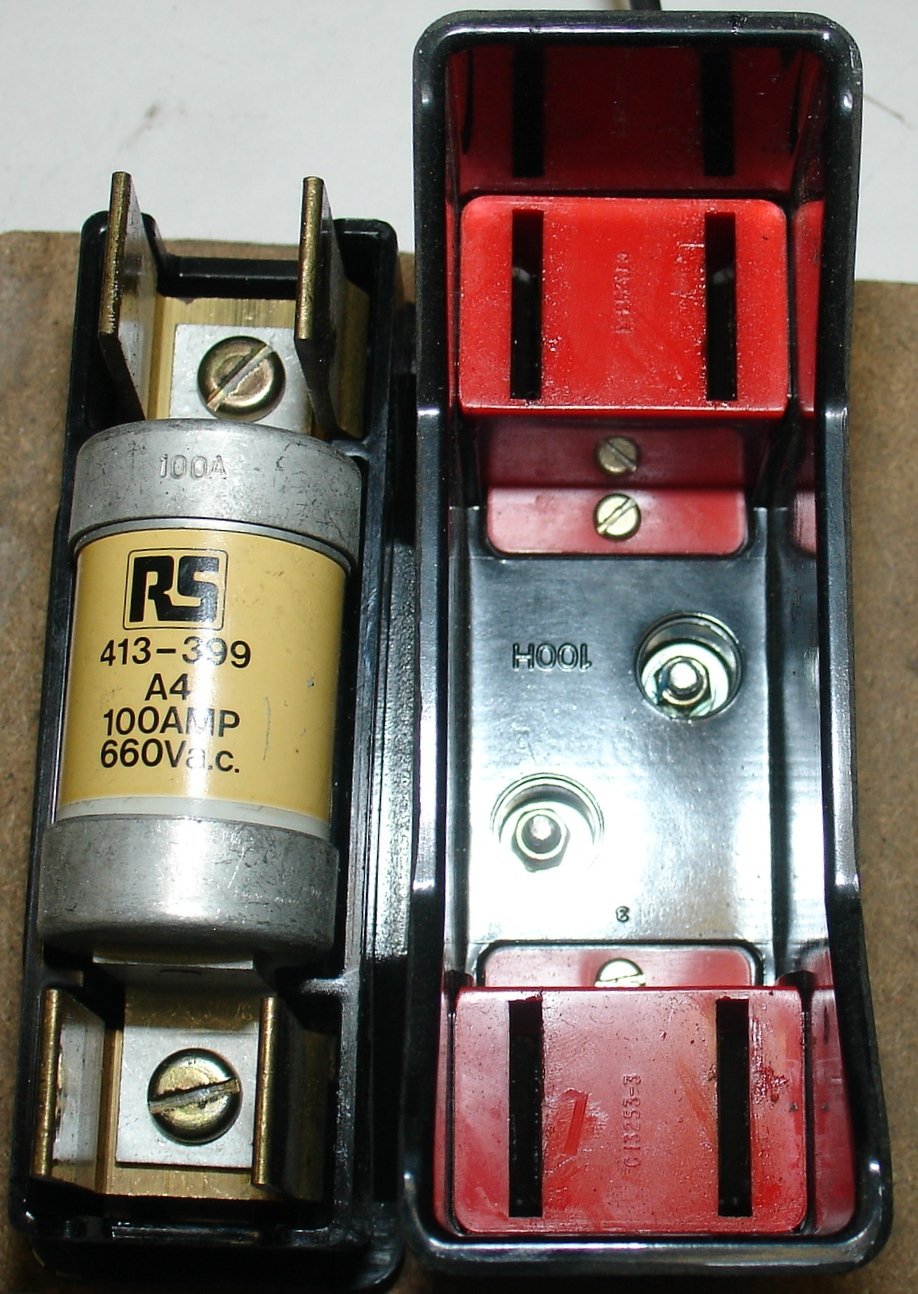
Fuses (simple, fast, one-time)
A fuse is a deliberate weak link: it opens when current exceeds its rating. Many solar builds use fuses on the battery side because they’re straightforward and come in high-current options.
Breakers (resettable, but DC ratings matter)
A breaker is resettable and can be convenient for testing or maintenance. The key is that DC interrupt ratings and voltage ratings must match your design.

The five places people get protection wrong
1) Battery-to-inverter protection
This is often where current is highest. Protection choices here should be tied to the inverter’s real draw, surge behavior, and the cable run.
Inverter sizing (watts, surge, draw) Solar wire size (amps + distance) Battery cable size for inverters
2) Controller-to-battery protection
Charge controllers can deliver substantial current into batteries. Protection here is about preventing wiring faults from turning into overheating or damage.
MPPT vs PWM (controller choice) Components overview
3) PV strings / combiner protection
Arrays with multiple strings may need string-level protection depending on the design. The safest approach is to follow the charge controller/combiner guidance for your configuration and voltage.
Series vs parallel solar panels Combiner boxes and disconnects
4) Loads and DC distribution
Small branch circuits (lights, DC outlets, fans) are where a clean distribution approach improves reliability. The goal is predictable protection, not “one big fuse for everything.”
5) Confusing disconnects with overcurrent protection
A disconnect makes a system safer to service, but it doesn’t necessarily protect wiring from overcurrent. Make sure you have both jobs covered where required.
A shopping checklist that prevents unsafe mismatches
- DC voltage rating: must be at or above your system voltage (and any array/open-circuit voltage where applicable).
- Interrupt rating: the device must be able to safely open the circuit under fault conditions.
- Current rating: match the circuit’s expected maximum current with appropriate design margin.
- Temperature/environment: some devices are not meant for heat, moisture, or outdoor exposure.
- Compatibility: match lugs, bus bars, cable size, and enclosure space.
If protection decisions are forcing awkward cable runs, revisit layout and voltage first: choose solar system voltage.
Worked sizing examples
Example 1 — string fuse for a 100 W panel with Isc ≈ 6 A
A typical 100 W panel lists a short-circuit current (Isc) around 6 A. That’s the number your string protection is sized from.
- PV circuit maximum current — NEC 690.8(A): maximum current = Isc × 1.25 = 6 A × 1.25 = 7.5 A.
- Conductor sizing — NEC 690.8(B): the wire must carry at least 125% of that maximum current = 7.5 A × 1.25 = 9.4 A minimum ampacity.
- Overcurrent protection — NEC 690.9(B): the fuse must be rated at no less than 125% of the 690.8(A) maximum current = 7.5 A × 1.25 = 9.4 A minimum — the same number as the wire, which is exactly how the code keeps the fuse protecting the conductor.
- Standard size: fuses come in standard ratings, so round up to the next standard size above 9.4 A → a 15 A class fuse for the string (standard fuse sizes include 10 A, then 15 A; some fuse families also list a 12 A step — pick the next standard rating your holder family offers, at or above 9.4 A, and never exceed the panel’s label max-fuse rating).
The short form of the same rule: fuse at Isc × 1.56 (1.25 × 1.25 = 1.5625) = 6 A × 1.56 = 9.4 A, rounded up to 15 A. That’s the multiplier you’ll see on this site’s sizing calculator. This math only matters when parallel strings can backfeed a faulted one — a single series string usually needs no string fuse, and the controller/combiner guidance plus your panel’s max-fuse label set the hard limits. Full NEC detail and the circuit-by-circuit planning flow live on the solar fuse and breaker sizing guide.
Example 2 — why the battery bank gets a breaker, and the battery lead still gets a terminal fuse
A battery-bank main is the classic breaker job: the main breaker is sized to the battery-to-inverter circuit, and because it’s resettable it doubles as the service disconnect — flip it off to work on the inverter side and you’ve isolated the bank without unwiring anything, and it resets after a genuine fault is found.
The battery lead itself is a different risk: a short anywhere in that high-fault-current cable is fed by the full bank, and the only way to shrink the unprotected run is to protect at the terminal. Marine practice (ABYC E-11, echoed on our DC arc-flash safety page) puts a Class T or MRBF fuse within ~150 mm (6–8 in) of the battery positive terminal in the main cable. If the main breaker sits right at the terminal and is DC- and interrupt-rated for the connection, it can serve this role; otherwise the terminal fuse protects the lead while the breaker (or a switch) provides the reset and the disconnect.
The wiring-decisions hub sums up the division of labor: this is the “battery-to-inverter fuse: Class T / MRBF territory — fast, DC-rated, near the terminal” boundary, with the terminal-distance rationale on the solar wiring decisions page and the full prevention ladder on DC arc-flash safety.
Common mistakes (risk → symptom → fix direction)
- Using AC breakers on DC circuits: can fail to interrupt safely; only use devices rated for your DC application.
- Protection too far from the battery: leaves more unprotected cable length than intended.
- Sizing protection to “what I plan to use”: protection should match potential circuit current, not a guess of normal usage.
- Using a disconnect as protection: different job; verify you have overcurrent protection where required.
FAQ
Do I need a fuse and a breaker?
What does “DC-rated” actually mean?
Where should the battery fuse go?
Do solar panels need fuses?
Can a breaker be used as a switch?
Next logical reads
Solar wiring and protection cost Solar wire size Series vs parallel solar panels Solar fuse and breaker sizing How to size an inverter MPPT vs PWM
Related guides: