Quick answer
Winterizing an off-grid system is five jobs, in this order: protect the batteries from cold charging (the only winter failure that permanently destroys hardware), re-set your harvest expectations to winter sun, manage snow and tilt on the panels, check the wiring and connections that cold contracts and condensation corrode, and triage your loads before the first deep freeze, not during it. Nothing here needs testing claims — it’s manufacturer spec math and physics you can verify against your own gear. Do the list once in autumn and your January self will thank you.
1. Batteries: the one mistake that’s permanent
The rule: LiFePO4 must never charge below 32°F/0°C — plating damage is permanent and invisible. Discharging is fine to about −4°F/−20°C. Lead-acid (flooded/AGM) can charge colder but loses capacity and needs full charge maintained to avoid freezing of a discharged electrolyte — a discharged flooded battery freezes far warmer than a charged one.
Your three options, worked in full in our LiFePO4 cold-charging guide: a self-heating lithium battery (100W pads warm cells before charging — LiTime’s Group 24 self-heating needs ≥10A charge current and spends ~120–150Wh per cold start, per manufacturer documentation retrieved 2026-09-06), thermostat heater pads and insulation for an existing bank, or strict charge-window discipline. If your battery has a low-temp cutoff, test that it works before you need it: a cutoff-equipped bank simply won’t charge on a freezing morning, and that’s the protection doing its job.
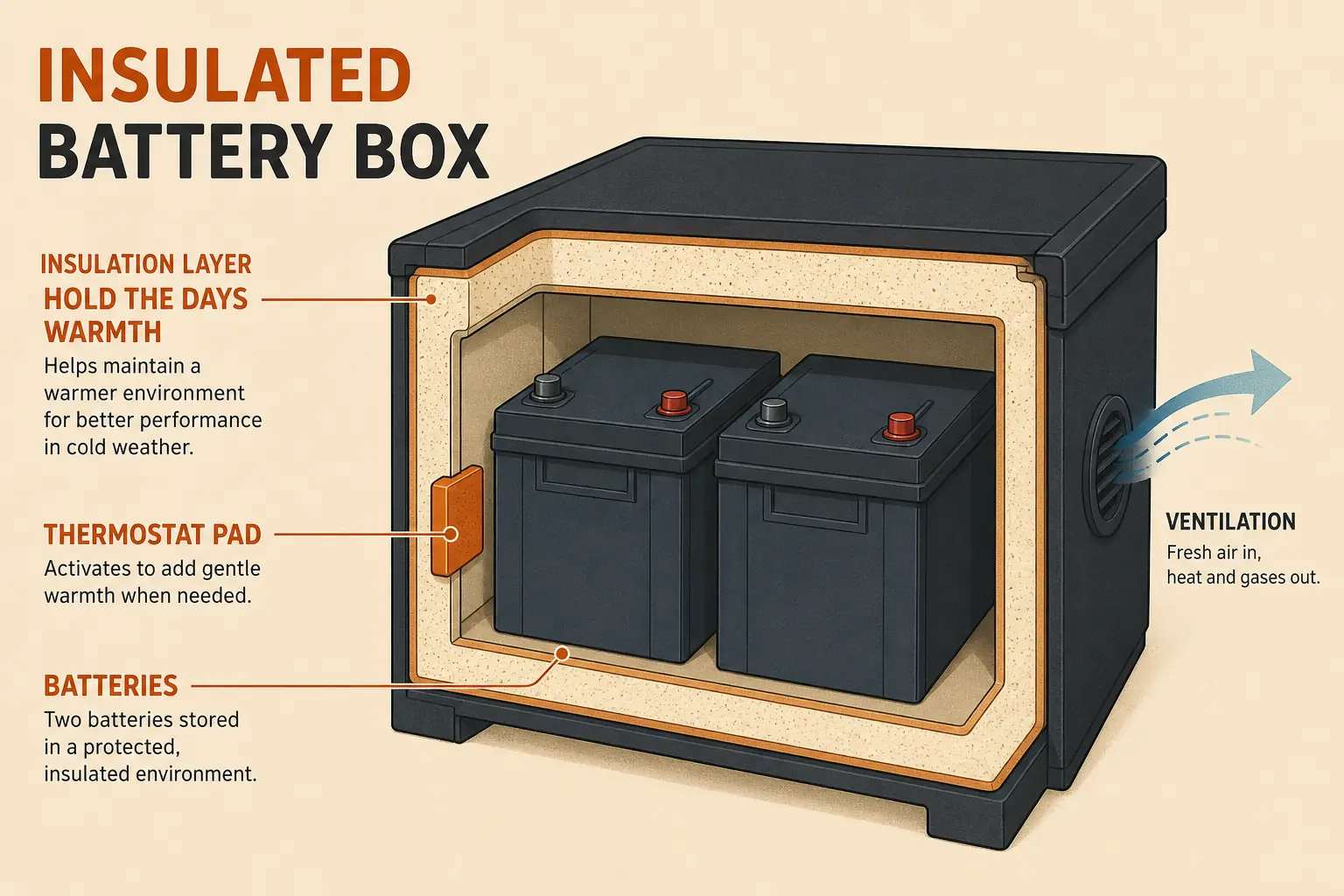
Winter battery box: insulation holds yesterday’s warmth into the night; a small thermostat pad covers the gap. Don’t smother — see the enclosure guide for venting rules by chemistry.
2. Reset your harvest math for winter sun
The trap isn’t weak equipment — it’s summer-sized expectations:
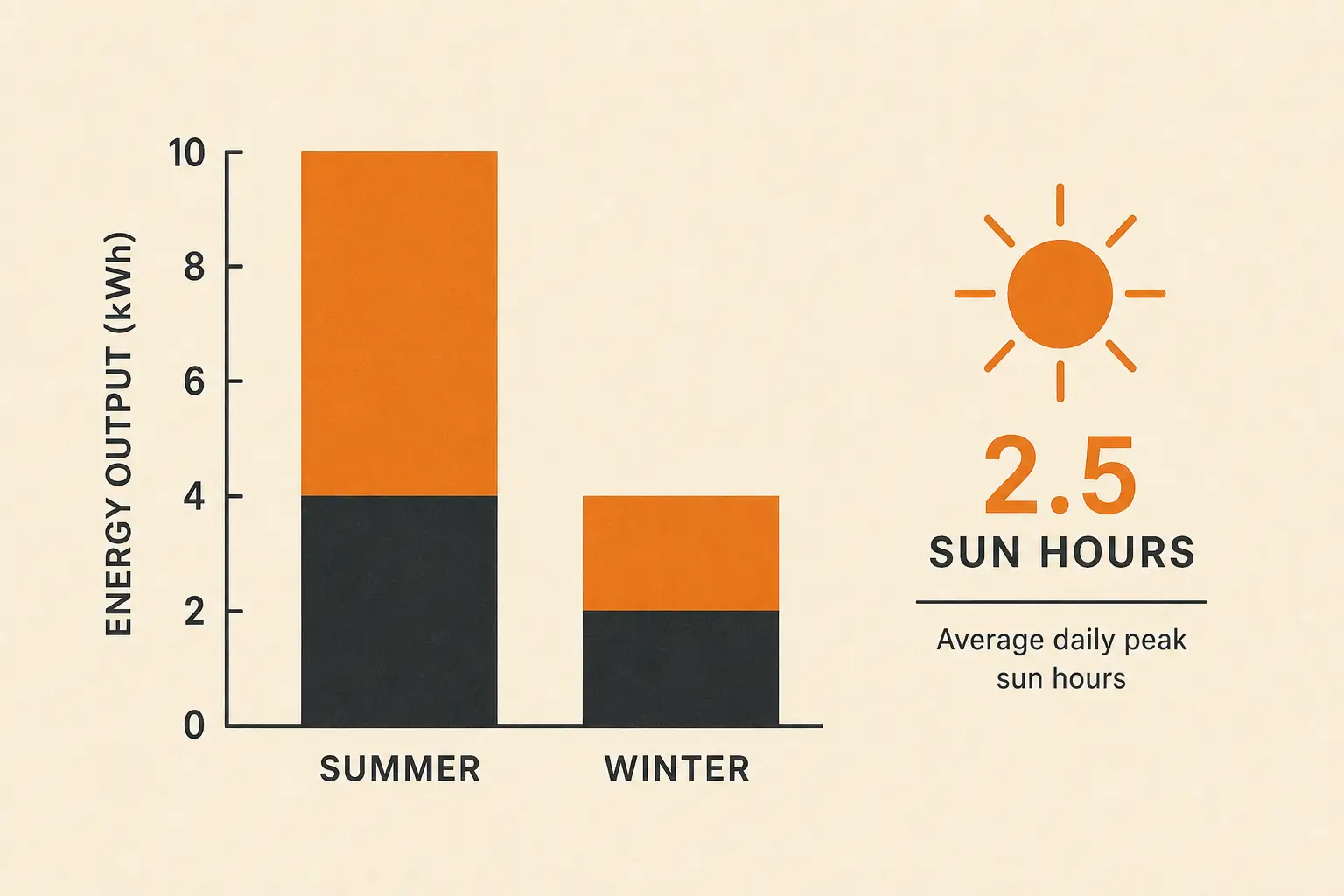
- Half the sun, roughly. Most continental-US sites see about 40–60% of summer’s peak sun hours in December (check your state in our peak sun hours tables). A system designed in July fails in December by arithmetic, not luck.
- Cold panels make more voltage, not more watts-hours. Cold raises panel voltage (good for harvest fraction), but the sun’s low angle and short days dominate. Size the hours, then the array.
- Snow on panels = zero. Even a thin crust can cut harvest to near-nothing (snow blocks light entirely; it’s not a partial filter).
Worked math: a 400W array at 2.5 peak sun hours (typical December, mid-tier state) → ~1,000Wh/day at 100% performance; real-world soiling, wiring, and cold-state charging losses put practical delivery nearer 700–850Wh. If your overnight load is 1,000Wh+, winter needs load triage, more panel, or a generator top-up — that’s the calculation to run now.
3. Panels: tilt, snow, and the ground-touch problem
- Steepen the tilt for winter — your latitude +15° is the classic winter angle; steeper also sheds snow. Adjustable mounts earn their cost exactly here.
- Snow management is manual. A soft roof brush on a pole before 10am, done safely from the ground. Never climb an icy roof for watt-hours.
- Watch the gap: panels mounted nearly flush to a surface ice up worse (no airflow behind). Ground mounts clear easily and are the winter-friendly choice — our ground-mount guide covers the tradeoffs.
- Don’t force harvest from a frozen bank: if the battery is below freezing with a cutoff, the panels idle — pair snow-clearing with the battery-box work in section 1.
4. Wiring and connections: what cold actually breaks
Copper contracts, connectors loosen, condensation creeps:
- Re-torque and re-seat: battery terminals, busbar bolts, MC4 pairs. A loose terminal reads fine until it’s a high-resistance hot spot under winter’s higher continuous loads. Our MC4 guide covers the two crimping mistakes that cause most failures.
- Inspect for corrosion at every connection you can reach; clean and protect.
- Voltage drop gets worse in the dark: winter means more amps for more hours through the same wires — re-check your cable sizes against winter loads, not summer ones.
- Fuses and breakers don’t go dormant either: verify ratings against the actual winter load list — the fuse and breaker sizing math is season-independent, but your load list isn’t.
5. Loads: triage before the freeze
Winter loads quietly grow (lights on longer, a small heater fan, the well pump’s pressure tank cycling harder):
- List the overnight Wh budget with winter runtimes — our load calculation guide does this in one table.
- Cut the vampires: anything with a standby draw is now a meaningful winter load.
- Pre-plan the backup decision: at what state-of-charge do you fire the generator? Decide at 70% SOC on a sunny day, not at 20% at 10pm. Our solar battery vs generator comparison frames the tradeoff.
- Know your state of charge, not your voltage guess: winter cold makes voltage readings lie worse than usual — a shunt-based monitor (the monitoring math is in our BMS guide) is the difference between managing and guessing.
The one-page checklist
| # | Task | Why | When |
|---|---|---|---|
| 1 | Confirm battery charge-temp spec; verify cutoff or add heating | Cold charging is permanent damage | Before first freeze |
| 2 | Insulate/heat the battery enclosure | Holds charge window open longer | Autumn |
| 3 | Re-run winter harvest math vs winter loads | The failure is arithmetic | Autumn |
| 4 | Steepen panel tilt; plan snow clearing | Snow = zero harvest | Before first snow |
| 5 | Re-torque terminals; inspect/clean connections | Cold loosens, condensation corrodes | Autumn |
| 6 | Verify cable/fuse sizing against winter loads | Longer dark = more amp-hours | Autumn |
| 7 | Set the generator/backup trigger SOC | Decide calm, not desperate | Autumn |
| 8 | Check SOC monitoring works (shunt, temp) | Winter voltage readings mislead | Autumn |
| 9 | Triage loads; kill standby draws | Every Wh counts at 2.5 sun hours | Early winter |
Frequently Asked Questions
Do solar panels work in winter?
What's the single most important winterizing step?
Should I take my batteries inside for winter?
How much does winter reduce my solar harvest?
Plan on roughly 40–60% of summer peak sun hours for much of the continental US in December, minus snow-cover days. Run your own numbers from our peak sun hours tables before the season, not during it.
Is it safe to put a heater pad in my battery box?
Next logical reads
LiFePO4 charging below freezing (the full math) Peak sun hours by state Battery enclosure guide How to calculate your solar load Solar battery vs generator
Peel-and-stick 12V pads with built-in thermostat (on near 45°F, off near 68°F per the manufacturer listing, retrieved 2026-09-06) — the class off-gridders mount under battery boxes to hold the charge window open. Not for: uncontrolled high-wattage heat near batteries, or substituting for a battery's own low-temp BMS logic. The honest tradeoff: they're designed for RV holding tanks, not batteries — sizing, mounting, and fire-safe clearance are your responsibility.
Check price on Amazon (opens in a new tab) Price & availability shown on Amazon.com — we may earn a commission.