Quick answer
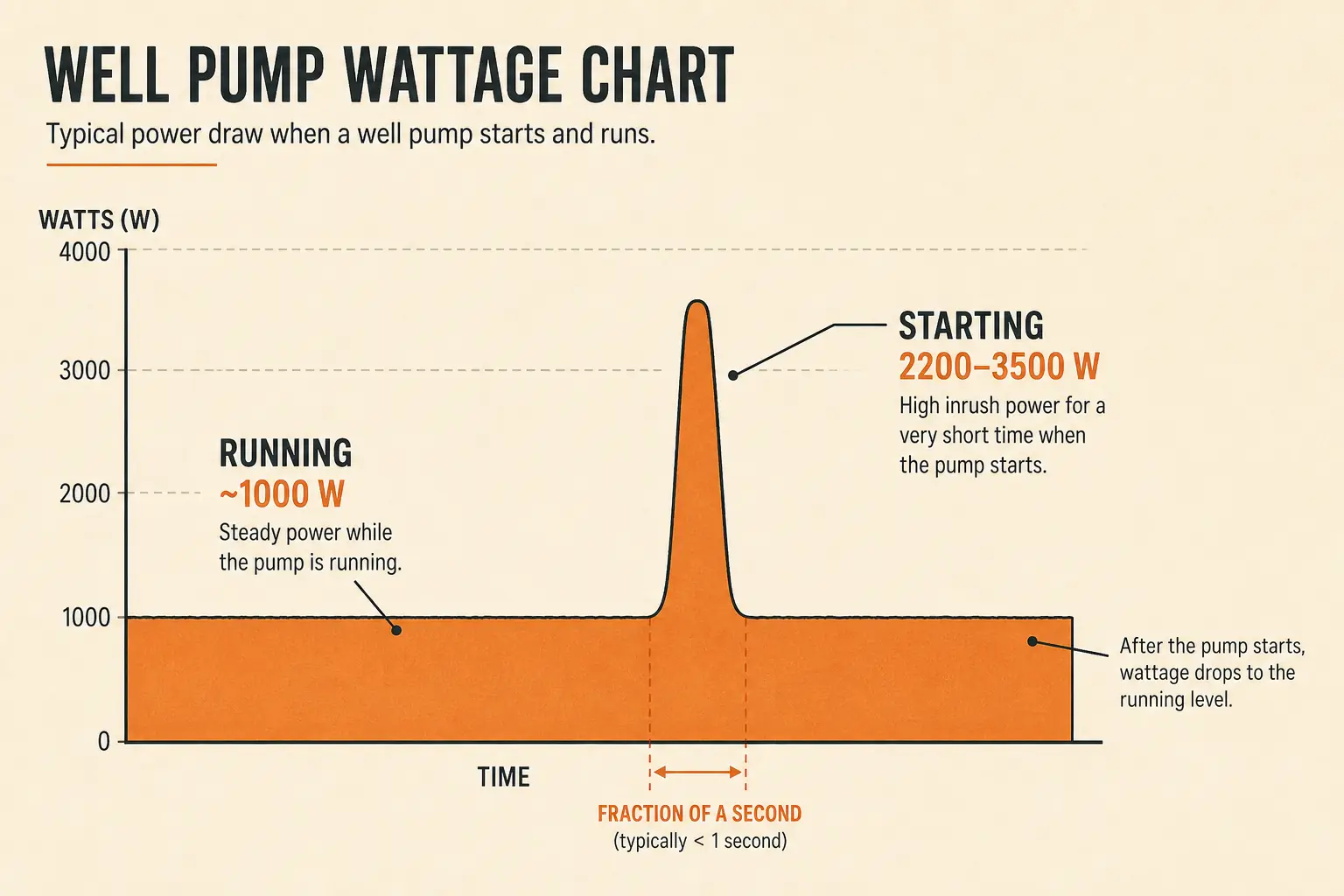
The size most people ask for and the size they need are different questions, because most deep-well pumps run on 240V — and almost every popular 1–2kWh power station only outputs 120V. No amount of wattage fixes the voltage mismatch: a ½ HP submersible needs ~900–1,200 running watts and 2,200–3,500W of starting surge at 240V (typical figures from pump-industry sizing guides and nameplate math; verify your own pump’s plate). Your real options: (1) a 120/240V-capable station rated ~4,000W+ (EcoFlow DELTA Pro 3 and Anker SOLIX F3800 are the current single-unit examples — specs below), (2) a 240V generator with a transfer switch — often the honest budget answer, or (3) if your water comes from a shallow well with a 120V jet pump, the ordinary 1–2kWh station class genuinely works. We’ll run all three calculations.
This page is sizing arithmetic and manufacturer-published specs — nothing here was bench-tested by us, and surge behavior varies pump to pump. Check your pump’s nameplate before buying anything.
Step 0: identify your pump (this decides everything)
| Pump type | Voltage | Typical running watts | Typical starting surge | Station-friendly? |
|---|---|---|---|---|
| Deep-well submersible (½–1½ HP, most rural wells) | 240V | ~900–1,200W (½ HP); ~1,840W (1 HP) | 2–3× running: ~2,200–3,500W (½ HP); ~5,500W+ (1 HP) | Only 240V-capable stations |
| Shallow-well jet pump (½–1 HP, wells to ~25 ft) | 120V (most) | ~600–1,000W | ~1,800–2,700W | Yes — 1–2kWh class works |
| 12V/24V DC pressure pumps (RV, cabin, tiny house) | 12/24V DC | 50–300W | 2–3× running | Any station with DC output or small inverter |
Surge multiplier per pump-industry sizing practice (motor inrush 2–3×); running watts per manufacturer sizing guides and the standard V×A nameplate math. Your pump’s nameplate is the authority.
The label on the pressure tank or the well cap, the breaker size in your panel (a 2-pole breaker = 240V), or the control box tells you which row you’re in. If it says 230V or 240V and two hots — you’re in row one, and the popular stations are out.
Why the voltage wall is absolute
A 120V-only inverter cannot produce 240V — there is no adapter, cable, or “surge protector” that changes this. Split-phase 240V is two 120V legs 180° out of phase; the station has to be built to output both. So the BLUETTI AC180 / Jackery Explorer 1000 class — perfectly good hardware, and exactly what our refrigerator sizing page recommends for fridges — is simply the wrong tool for a submersible. Anyone telling you otherwise is selling something.
Option 1: a 240V-capable station (the money answer)
Two current single-unit examples that output both 120V and 240V (specs per manufacturer/retailer listings, retrieved 2026-09-06; both expandable with extra batteries):
| Spec | EcoFlow DELTA Pro 3 | Anker SOLIX F3800 |
|---|---|---|
| Rated AC output | 4,000W | 6,000W |
| Voltage | 120V/240V in one unit | 120V/240V split-phase |
| Capacity (base unit) | 4,096Wh (LFP), expandable | 3,840Wh (LFP), expandable |
| Surge handling | EcoFlow’s own well-pump guide sizes it for 1½–2 HP submersibles | 9,000W surge per manufacturer |
| Solar input | up to 2,600W | 2,400W |
BLUETTI’s route is different: the AC500 needs two units bonded for 240V split phase — workable, more modular, more assembly. (All per manufacturer documentation; we’ve tested none of it.)
The sizing math for a ½ HP submersible: running ~1,000W, starting ~3,000W at 240V → either unit clears the surge (per the manufacturers’ own compatibility guides) and runs the pump with the whole rest of its capacity available for fridge/freezer/internet — which is why these are “home backup” class rather than “gadget” class products.
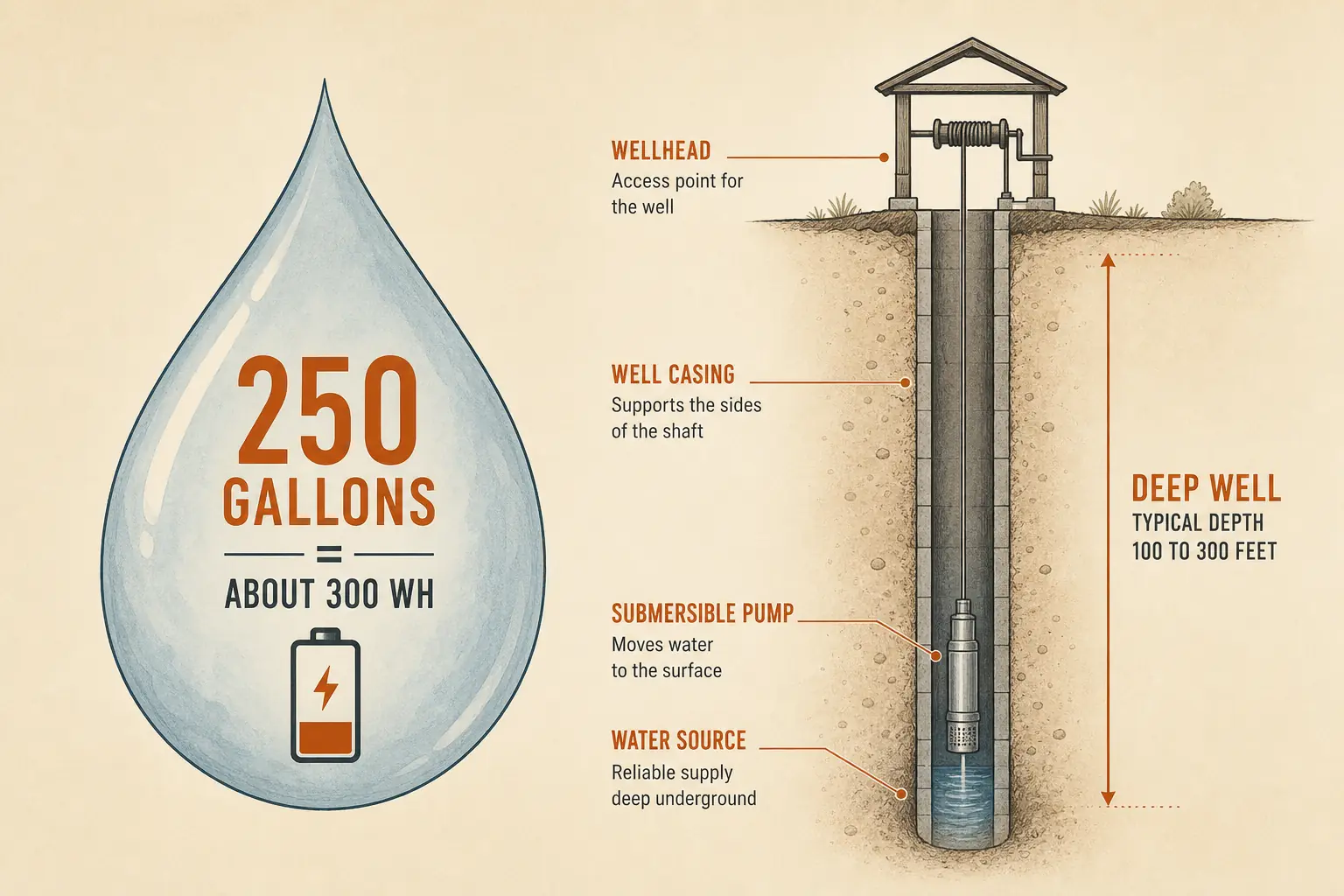
Runtime per day — the honest good news. Pumping water is energetically cheap. Lifting 250 gallons (≈946 kg) up a 200-ft (61 m) well is m·g·h ≈ 946 × 9.81 × 61 ≈ 157Wh of hydraulic work; at a realistic 45–55% wire-to-water efficiency for a small submersible, that’s roughly 290–350Wh of electricity per day for a typical household’s water. A 4kWh-class station pumps your household water for the better part of a week. The surge is the hard part, not the energy.
Option 2: a 240V generator (the budget answer)
A quality 4,000W+ dual-fuel inverter generator with a 240V outlet, a transfer switch or inlet box installed by an electrician, and a pressure tank that limits cycles: often half the cost of a 4kWh 240V station for unlimited runtime. The tradeoffs are the ones in our solar battery vs generator comparison: fuel logistics, noise, maintenance, and the fact that it’s backup-only, not solar-rechargeable. For an outage-focused household on a budget, this is frequently the honest recommendation — a site that earns your trust saying so earns it back later.
Option 3: the 120V path (if your pump cooperates)
Shallow-well jet pumps (120V) and 12V DC pressure pumps are the stations’ home turf:
- ½ HP 120V jet pump: ~600–900W running, ~1,800–2,700W starting → a station with 1,800W+ rated output and ~2,700W+ surge runs it (the BLUETTI AC180 class — 1,152Wh, 1,800W — sits right at this line; check your pump’s nameplate surge).
- 12V DC diaphragm pumps (RV/cabin class): 50–300W — practically any station runs these, and a 100Ah LiFePO4 + small inverter does it without a station at all (our 100Ah runtime math).
If you’re designing an off-grid water system rather than backing up an existing one, choosing a 120V jet pump or a DC pump up front is what makes the affordable station class usable.
The soft-start wildcard
A soft-start kit (or a VFD pump controller) reduces a submersible’s inrush toward its running current — pump-industry practice for generator and inverter sizing. It can shrink the station class you need (and is standard on many modern pumps). It’s electrical work on a 240V circuit: licensed-electrician territory, and it changes the surge row of the table above in your favor. Verify your pump model’s compatibility before counting on it.
Safety and wiring notes (non-negotiable)
- Never backfeed a panel from any station or generator. A proper transfer switch or interlock, installed to code, is the only connection to household wiring.
- Grounding and bonding for a permanently installed station or generator follow your local code — this is inspection-grade work.
- The 240V stations above are heavy, and their solar-input windows assume big arrays; read our inverter loading guide for why running anything at 100% of rated watts is the wrong habit.
Frequently Asked Questions
Can a Jackery or BLUETTI 1000Wh station run my well pump?
How many watts does a well pump use per day?
What size solar generator runs a 1 HP submersible?
Is a generator better than a power station for well-pump backup?
Can I use a pressure tank to reduce the load?
Next logical reads
Jackery vs EcoFlow: the capacity-class math What size station runs a refrigerator Solar generators: the honest guide Solar battery vs generator Inverter sizing 100Ah battery runtime math
4,000W rated AC with native 120V/240V output in one unit, 4,096Wh LiFePO4 expandable to 48kWh, up to 2,600W solar input (per manufacturer/retailer listing, retrieved 2026-09-06); EcoFlow's own well-pump guide sizes it for 1½–2 HP submersibles. Not for: budget-first backup where a 240V generator and transfer switch do the same job for less, or 120V-only loads that don't need this class. The honest tradeoff: whole-home-class capability at whole-home-class cost, and the surge headroom only pays off if you actually have a 240V load like a submersible pump.
Check price on Amazon (opens in a new tab) Price & availability shown on Amazon.com — we may earn a commission.