Key takeaways
- Batteries are the single most failure-prone and expensive component in an off-grid solar system — proper maintenance can double their working lifespan.
- Flooded lead-acid batteries need regular watering with distilled water, terminal cleaning, and periodic equalization charges; sealed AGM and gel batteries skip the watering.
- Lithium (LiFePO4) batteries need almost no maintenance, but they must never be charged below freezing without a built-in heater or low-temperature cutoff.
- Never mix old and new batteries in the same bank — the new ones will degrade down to the weakest old battery within months.
- Replace the entire battery bank at once, not one battery at a time, to avoid capacity mismatches and premature failure.
Why battery maintenance matters
In any off-grid or battery-based solar system, the battery bank is the heart of the setup — and the most expensive part to replace. Panels quietly produce power for 25+ years. A charge controller might run a decade without complaint. But batteries? They age, sulfate, stratify, and fail. A flooded lead-acid bank that should last 7 to 10 years can be destroyed in 18 months by chronic undercharging, neglect, or a single brutal winter.
The good news: battery maintenance is not complicated. It comes down to keeping the right charge level, protecting against temperature extremes, cleaning connections, and knowing when a bank has reached end-of-life. This guide covers the practical steps for both lead-acid and lithium batteries, with specific voltages, schedules, and warning signs.
For a deeper comparison of battery chemistries, see Li-ion vs lead-acid batteries and our solar battery cost per kWh breakdown.
Understanding the three charging phases
Every solar charge controller (MPPT or PWM) cycles batteries through three phases. Understanding these phases is the foundation of battery care, because most premature failures trace back to a controller misconfigured for the wrong battery type.
1. Bulk phase
The controller delivers maximum available current to push battery voltage up toward its absorption setpoint. During bulk, the battery accepts all the current the panels can produce. This is the fastest phase — think of it as the “main recharge” that gets the bank from a low state up to roughly 80% full.
2. Absorption phase
Once the battery hits its target voltage (typically 14.4V to 14.8V for a 12V flooded lead-acid bank, 14.2V to 14.4V for AGM, and 14.2V to 14.6V for lithium), the controller holds that voltage steady and lets the current taper off. As the battery fills, it naturally accepts less current. Absorption usually runs for a fixed time window (1 to 3 hours) or until current drops below a threshold. This phase is critical — if the controller exits absorption too early, the battery never reaches full charge and will sulfate.
3. Float phase
After absorption completes, voltage drops to a maintenance level — around 13.5V for flooded lead-acid, 13.4V for AGM, and 13.4V to 13.6V for lithium. Float is a trickle charge that exactly offsets the battery’s natural self-discharge, keeping it at 100% without overcharging. A bank held in float indefinitely is safe; a bank left partially charged for weeks is not.
The takeaway: make sure your charge controller profile actually matches your battery chemistry. Setting a lithium profile on a lead-acid bank (or vice versa) will shorten battery life dramatically. If your system isn’t cycling through these phases correctly, see our solar battery not charging troubleshooting guide.
Flooded lead-acid maintenance
Flooded (wet-cell) lead-acid batteries are the workhorses of off-grid solar. They’re cheap per kWh, tolerate abuse reasonably well, and can last 7 to 10 years if cared for. The trade-off is real maintenance work every 1 to 3 months.
Watering
As flooded lead-acid batteries charge, electrolysis splits water in the electrolyte into hydrogen and oxygen gas. The gas vents, and the water level drops. If plates become exposed, the battery suffers permanent damage. The fix is simple: top up with distilled water only — never tap water, never bottled mineral water. Minerals and chlorine destroy the plates.
Check water levels monthly during heavy-use periods and every 2 to 3 months otherwise. Fill to the bottom of the fill tube (the split-ring indicator), not to the very top. Overfilling causes acid to spew out during charging. Only water a battery after charging, not before — the electrolyte expands as it charges.
Terminal cleaning
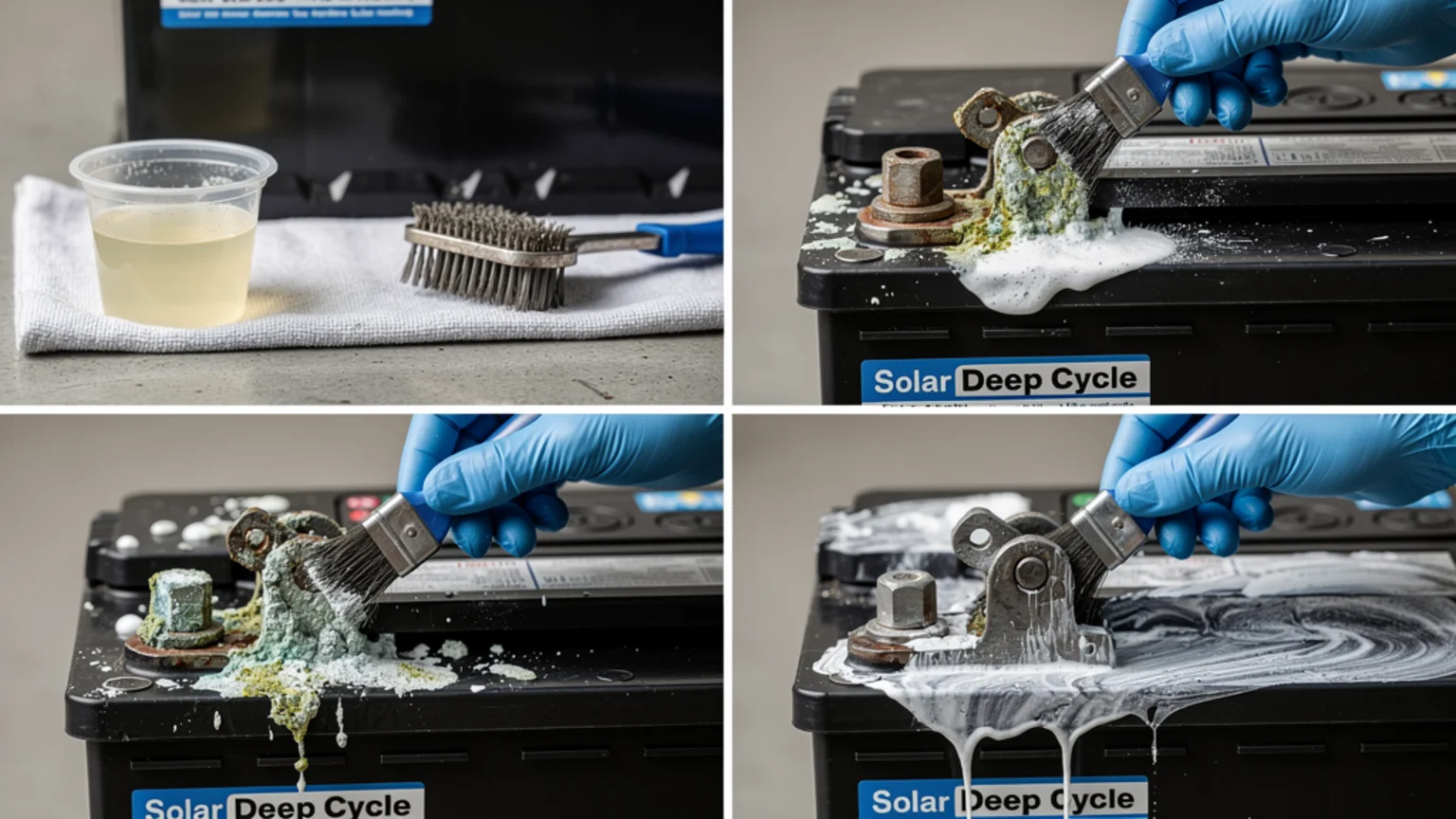
Corrosion builds up on lead-acid terminals as a white, green, or blue crust. It increases resistance, which causes voltage drop and heat — both of which waste energy and shorten battery life. Clean terminals every 3 to 6 months:
- Disconnect the battery (negative terminal first).
- Mix baking soda with a little distilled water to form a paste.
- Apply to the terminals and let it fizz — the reaction neutralizes acid deposits.
- Scrub with a brass or stainless terminal brush.
- Rinse with distilled water and dry thoroughly.
- Reconnect, then coat terminals with a thin layer of dielectric grease or petroleum jelly to slow future corrosion.
Ventilation
Charging flooded lead-acid batteries produces hydrogen gas — flammable and explosive in concentrations above 4%. The battery enclosure must vent to the outside. Never smoke or create sparks near a charging lead-acid bank. This is a hard safety rule, not a preference. See our solar battery enclosure guide for venting specifics.
Equalization
Over time, individual cells in a flooded lead-acid battery drift out of balance, and sulfate crystals build up on the plates. An equalization charge corrects both problems: the controller applies a controlled overvoltage (typically 15.0V to 15.5V for a 12V bank) for 1 to 3 hours, intentionally boiling the electrolyte to mix it and knock sulfate off the plates.
Equalize flooded batteries every 1 to 3 months, or whenever specific gravity readings between cells vary by more than 0.030. Never equalize sealed batteries (AGM, gel, VRLA) — the sealed construction traps gas, and overvoltage will vent electrolyte that can’t be replaced, permanently damaging the battery. Lithium batteries should never be equalized either.
During equalization, remove all loads, ensure the enclosure is well-ventilated, and top up with distilled water afterward (the process consumes water).
Sealed lead-acid (AGM and gel) maintenance
AGM (Absorbent Glass Mat) and gel batteries are VRLA — Valve Regulated Lead-Acid. They’re sealed, so there’s no watering, no equalization, and far less hydrogen venting. This makes them popular for RVs, boats, and indoor installs where maintenance access is limited.
The trade-off: they’re more sensitive to overcharging and heat. Set your charge controller to the exact AGM or gel profile the manufacturer specifies. Overvoltage on a gel battery can create gas bubbles that permanently reduce capacity. AGM tolerates slightly higher voltages but still won’t forgive chronic overcharging.
The main “maintenance” for sealed lead-acid is monitoring. Keep terminals clean (same baking soda method, but be careful not to let liquid enter the vents), keep the batteries in a temperature-stable location, and watch for swelling — a bulging VRLA case indicates internal gas buildup and a battery near failure.
Lithium (LiFePO4) maintenance
Lithium iron phosphate batteries changed the economics of off-grid solar. They offer 85% to 100% depth of discharge (versus 50% max for lead-acid), round-trip efficiency of 95% (versus 80–85% for lead-acid), and lifespans of 10 to 15 years or 4,000 to 6,000 cycles. They’re also nearly maintenance-free — no watering, no equalization, no terminal corrosion from vented gas.
But lithium has one hard rule that catches people off guard: never charge a LiFePO4 battery below 0°C / 32°F. Charging below freezing causes lithium plating on the anode, which permanently destroys capacity and can create an internal short — a fire risk. If your battery bank lives in an unheated shed in a cold climate, you need either:
- A battery with a built-in self-heating mat (many modern LiFePO4 packs include this), or
- A charge controller with a low-temperature cutoff sensor that blocks charging until the battery warms up, or
- A heated enclosure (see enclosure guide).
Discharging lithium in the cold is fine — it’s only charging that’s dangerous. And lithium actually tolerates heat better than lead-acid, though sustained temperatures above 45°C (113°F) will still shorten lifespan.
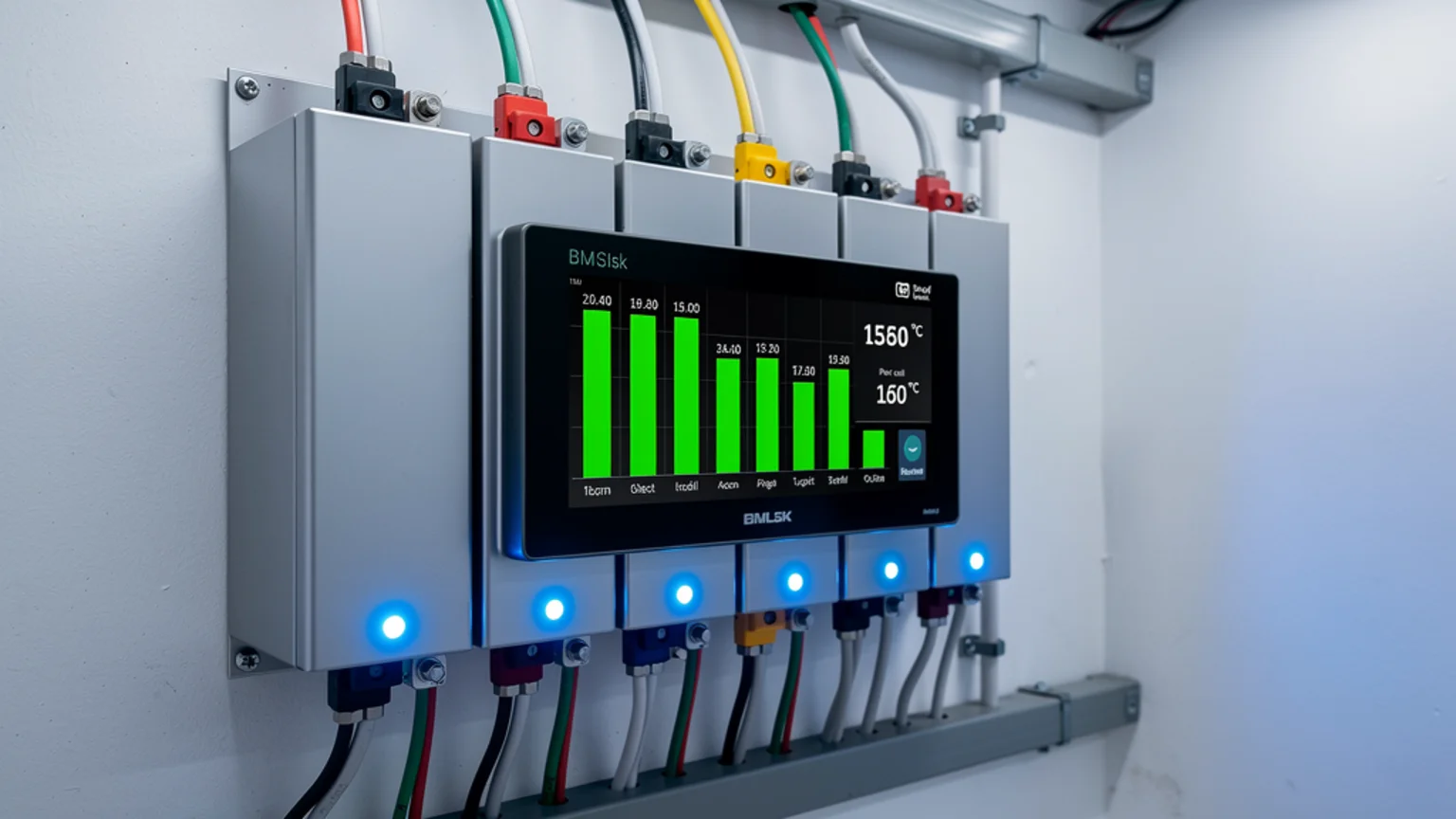
Otherwise, lithium maintenance is minimal: keep terminals torqued to spec, keep the battery management system (BMS) firmware updated if applicable, and store the bank at 40–60% state of charge if you’re shutting the system down for an extended period.
Depth of discharge: the single biggest lifespan factor
How deeply you discharge your batteries before recharging — depth of discharge (DoD) — has more impact on lifespan than almost any other variable. This is true for both chemistries, but the rules differ sharply.
| Factor | Flooded lead-acid | Lithium (LiFePO4) |
|---|---|---|
| Max recommended DoD | 50% | 80–100% |
| Ideal daily DoD | 20–30% | 10–80% |
| Typical lifespan | 7–10 years | 10–15 years |
| Round-trip efficiency | 80–85% | 95% |
| Freeze tolerance | Tolerates freezing | Never charge below 0°C |
| Maintenance | Watering, cleaning, equalization | Minimal |
For lead-acid, discharging below 50% regularly will cut lifespan in half or worse. A bank that should run 8 years might die in 3. If you need to regularly discharge deeper than 50%, you either need a larger bank or you should switch to lithium. Use our battery capacity calculator to size correctly.
Lithium is far more forgiving — you can discharge to 80% or even 100% daily with minimal lifespan penalty. This is why a 100Ah lithium battery effectively matches a 200Ah lead-acid bank: the lead-acid unit only gives you 100Ah of safe discharge, and the lithium gives you 80–100Ah — at half the weight, and it holds that output better as it discharges.
Winter care
Lead-acid in winter
Flooded lead-acid batteries tolerate freezing surprisingly well when fully charged — a fully charged battery freezes around -70°F (-57°C). But a discharged battery freezes near 20°F (-7°C), and frozen electrolyte expands, cracking the case and destroying the battery. In cold climates, the rule is simple: keep the bank charged. If your solar input drops in winter, supplement with a generator or grid charger to prevent the bank from sitting discharged.
Cold also reduces lead-acid capacity. A battery bank at 32°F may only deliver 75% of its rated capacity. This is temporary — capacity returns as the battery warms — but it means you should oversize a cold-climate bank by 20–25%.
Lithium in winter
Lithium batteries lose very little capacity in the cold (roughly 5–10% at 32°F), but the charging restriction is the challenge. Options:
- Heated lithium batteries — many manufacturers now build a thin heating pad into the battery case. When the BMS detects charging current at low temperature, it routes power to the heater first, warming the cells to 5°C before allowing charge. These add $100–$300 per battery but solve the problem entirely.
- Low-temperature cutoff — a temperature sensor on the battery tells the charge controller to stop charging below 0°C. The battery sits discharged until it warms, which is safe but means you lose solar input during cold snaps.
- Heated enclosure — insulate the battery box and add a small thermostat-controlled heater (see enclosure guide). This works for any chemistry.
The full seasonal list — panels, tilt, wiring, load triage — is in our winterizing checklist, and the cold-charging chemistry and heater math are in the LiFePO4 below-freezing guide.
When to replace your battery bank
Batteries don’t die on a schedule — they degrade gradually, then sometimes fail abruptly. Watch for these signs:
- Capacity loss: If a bank that used to last two days now lasts one, capacity has dropped significantly. For lead-acid, measure specific gravity with a hydrometer; readings consistently below 1.225 after a full charge indicate sulfation and near end-of-life.
- Rapid voltage drop under load: A healthy 12V bank holds above 12.0V under moderate load. If voltage sags to 11.0V or below quickly, internal resistance is climbing.
- One bad battery in a series string: If one battery fails, the entire bank’s performance drops to that battery’s level. Test each battery individually with a load tester.
- Physical signs: Swollen or cracked cases, persistent heating, smell of sulfur (rotten eggs) — these indicate imminent failure or danger.
The golden rule: replace the entire bank at once
When it’s time to replace, replace every battery in the bank at the same time, with identical make and model. Never mix old and new batteries. A new battery paired with old ones will be dragged down to the weakest battery’s performance — the old batteries force the new one to work harder, accept more current, and age faster. Within months, the new battery matches the degraded old ones, and you’ve wasted your money.
This applies to mixing different brands, capacities, or ages in general. In a series string especially, every battery should be the same age, same model, same capacity, and ideally from the same production batch. Mismatched batteries create imbalance that no charge controller can fully correct.
Maintenance schedule summary
Flooded lead-acid
| Frequency | Task |
|---|---|
| Monthly | Check water levels in heavy-use periods; top up with distilled water if needed |
| Every 1–3 months | Equalization charge (check specific gravity first) |
| Every 3–6 months | Clean terminals; inspect for swelling or leaks; torque connections |
| Annually | Full specific gravity test of all cells; check charge controller setpoints |
Sealed lead-acid (AGM/gel)
| Frequency | Task |
|---|---|
| Every 3–6 months | Inspect terminals and case for swelling; clean terminals if corroded |
| Annually | Check charge controller voltage setpoints; verify no overcharging |
Lithium (LiFePO4)
| Frequency | Task |
|---|---|
| Every 6 months | Inspect terminals and torque to spec; verify BMS status and cell balance |
| Annually | Verify low-temperature cutoff or heater is functioning; check firmware |
FAQ
How often should I add water to my flooded lead-acid batteries?
Can I mix AGM and flooded lead-acid batteries in the same bank?
Do lithium batteries need a battery management system?
What voltage should my 12V battery bank rest at when fully charged?
Is it okay to leave batteries partially charged for a few days?
How do I know if my battery bank is failing?
Next logical reads
Battery monitoring guide (know your real state of charge) Li-ion vs lead-acid comparison Solar battery cost per kWh Battery capacity calculator Solar battery not charging troubleshooting Solar maintenance checklist
Related guides: