Quick verdict
The LiTime 12V 100Ah is a 12.8V, 1,280Wh LiFePO4 deep-cycle battery in a Group 31 case with a 100A BMS and a 5-year warranty (per manufacturer spec) — the model this site’s sizing math most often lands on for 12V storage banks, RVs, cabins, and small off-grid systems. The spec that decides fit is your inverter’s continuous draw against the 100A BMS ceiling: one battery honestly carries about a 1,000W continuous inverter, no more. The tradeoff to know before buying: this base model has no low-temperature charge protection — the manufacturer’s own documentation says charge it only above 32°F — and no built-in Bluetooth (a separate version of each exists).
What this review is (and isn’t). This is a spec-based review. We did not bench-test this battery, and no manufacturer sent it to us. Every number below comes from the manufacturer’s published documentation, marked “per manufacturer spec” with the retrieval date; warranty terms come from the manufacturer’s warranty page. How products earn a mention on this site: how we recommend.
Already know your loads land under the 100A ceiling and your battery lives above freezing? Check price on Amazon (opens in a new tab) — the full spec table, the ceiling math, and the warranty fine print are below if you’d rather run the numbers first.
Key specifications
| Spec | Value | Source |
|---|---|---|
| Nominal voltage / chemistry | 12.8V, LiFePO4 (4-cell) | per manufacturer spec, retrieved 2026-09-06 |
| Rated capacity / energy | 100Ah / 1,280Wh | per manufacturer spec, retrieved 2026-09-06 |
| BMS continuous discharge | 100A (1,280W max continuous output) | per manufacturer spec, retrieved 2026-09-06 |
| Peak discharge | 400A for 1 second | per manufacturer spec, retrieved 2026-09-06 |
| Recommended charge current | 20A (0.2C, ~5 h) or 50A (0.5C, ~2 h); 100A max | per manufacturer spec, retrieved 2026-09-06 |
| Charge voltage | 14.4V ± 0.2V (CC/CV) | per manufacturer spec, retrieved 2026-09-06 |
| Charge temperature range | 32°F to 122°F (0°C to 50°C) | per manufacturer spec, retrieved 2026-09-06 |
| Discharge temperature range | −4°F to 140°F (−20°C to 60°C) | per manufacturer spec, retrieved 2026-09-06 |
| Low-temp charge protection / self-heating | None on this base model (heated versions sold separately) | per manufacturer spec + product FAQ, retrieved 2026-09-06 |
| Cycle life (claimed) | 4,000 cycles @ 100% DOD; 6,000 @ 80%; 15,000 @ 60% | per manufacturer spec — a lab claim, not our measurement |
| Case / size / weight | ABS, IP65; Group 31 footprint (L13 × W6.77 × H8.43 in); ~24.25 lbs | per manufacturer spec, retrieved 2026-09-06 |
| Terminals | M8 bolts | per manufacturer spec, retrieved 2026-09-06 |
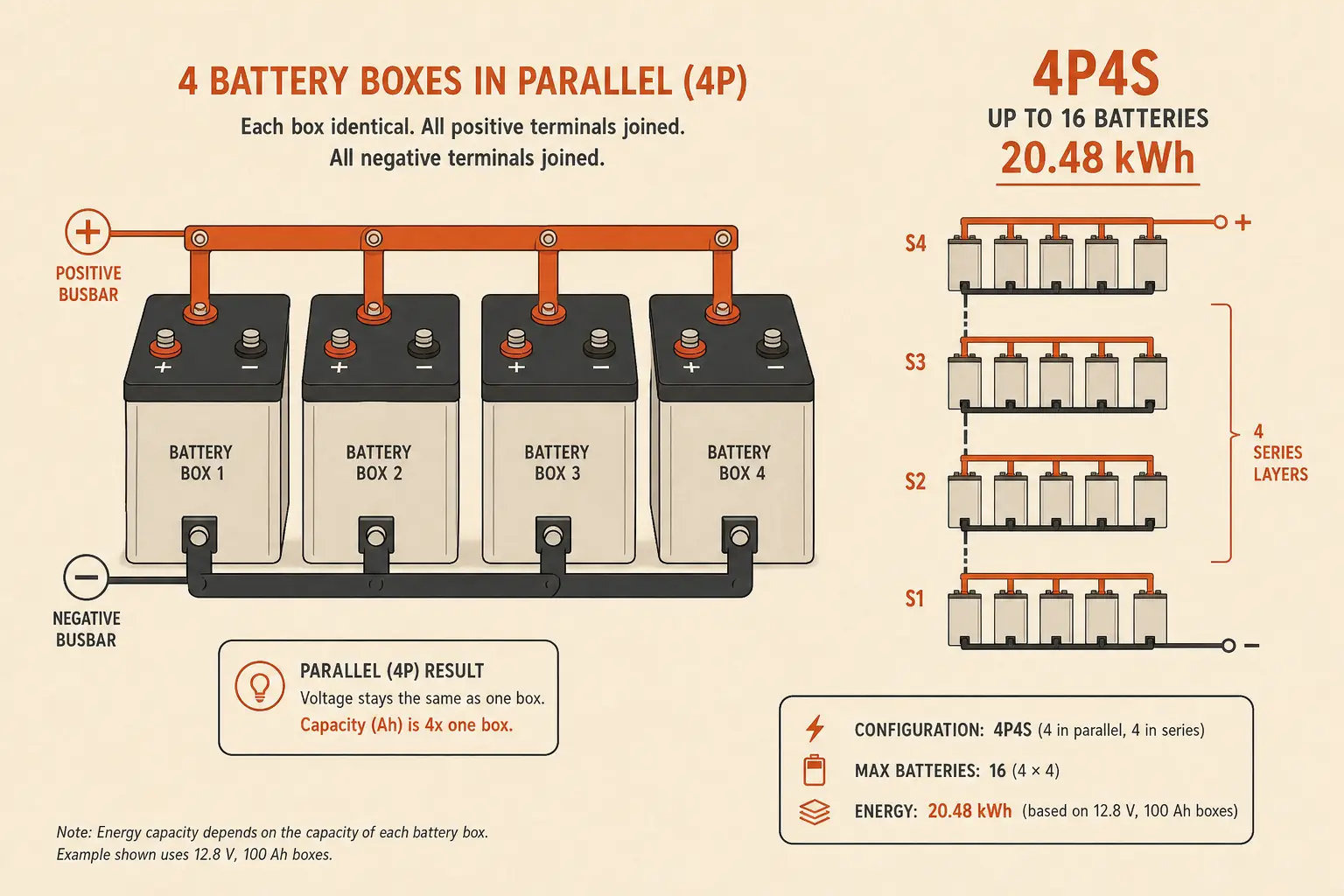
| Expansion | Up to 4P4S (16 batteries, 20.48kWh); identical models matched within 0.1V | per manufacturer spec, retrieved 2026-09-06 |
| Monitoring | None on base model (Bluetooth version sold separately) | per manufacturer spec, retrieved 2026-09-06 |
| Warranty | 5 years | per manufacturer warranty policy (litime.com), retrieved 2026-09-06 |
| Typical price class | The value anchor of the 100Ah class — list around $280, frequently below it | editorial band, checked Sep 2026 — Amazon shows the current price |
Specs verified as of 2026-09-06 against the manufacturer’s published documentation — verify against the live datasheet before buying; specs drift, and warranty terms can differ by seller and region.
What the specs mean for your build
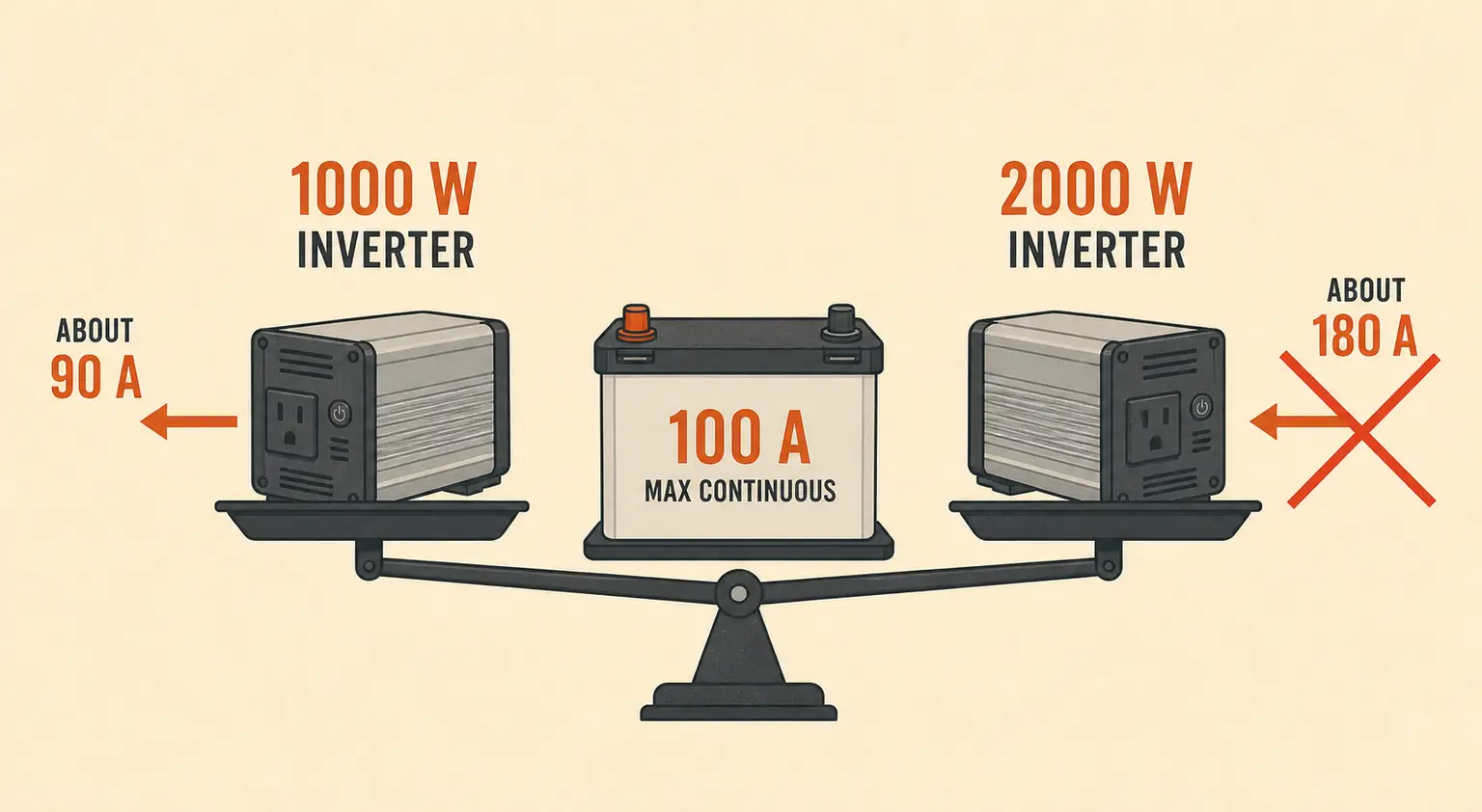
The 100A ceiling — the one calculation that decides everything. A battery’s BMS continuous rating caps the draw you can place on it. At 12.8V, 100A is a 1,280W ceiling (per manufacturer spec). Inverters are ~85–90% efficient, so a 1,000W continuous load pulls roughly 1,000 ÷ 12.8 ÷ 0.87 ≈ 90A from the battery — inside the ceiling with a little margin. A 2,000W inverter at full load pulls ≈ 180A — past it, and the BMS will disconnect. That’s not a flaw in this battery; it’s the arithmetic of every single 100Ah/100A unit in this class. The fix is parallel batteries (two of these = 200A ceiling), not a bigger single battery.
The surge story. The 400A-for-1-second rating is what lets an inverter start a fridge or a well pump: compressor startup can draw 3–6× running current for a fraction of a second. A 1,000W inverter starting a 600W fridge might briefly ask for ~1,800W ≈ 160A — well within 400A for one second. Surge is for starting, never for running.
Runtime math. Usable energy = Ah × V × depth of discharge. At a conservative 80% DOD: 100 × 12.8 × 0.8 ≈ 1,024Wh usable. That runs a 60W CPAP setup for ~17 hours, a 150W fridge cycling at ~40W average for about a day, or a 500W workshop load for two hours. The full worked examples live in how long will a 100Ah battery run.
Charging it honestly. The manufacturer’s sweet spots are 20A (about a 5-hour full charge) or 50A (about 2 hours). To hit a 20–30A charge current from solar you want roughly 300–400W of panel behind a 30A-class MPPT controller — which is exactly the pairing our controller guide lands on for this battery class. Charging at the 100A maximum is allowed but buys little and stresses everything downstream.
Scaling the bank. Up to 4 parallel × 4 series (16 batteries, 20.48kWh — per manufacturer spec), with the usual strings attached: identical models, similar age, and packs matched within 0.1V before connecting. For most cabin builds the realistic path is 2–4 in parallel on a busbar — see our BMS and bank-building guide.
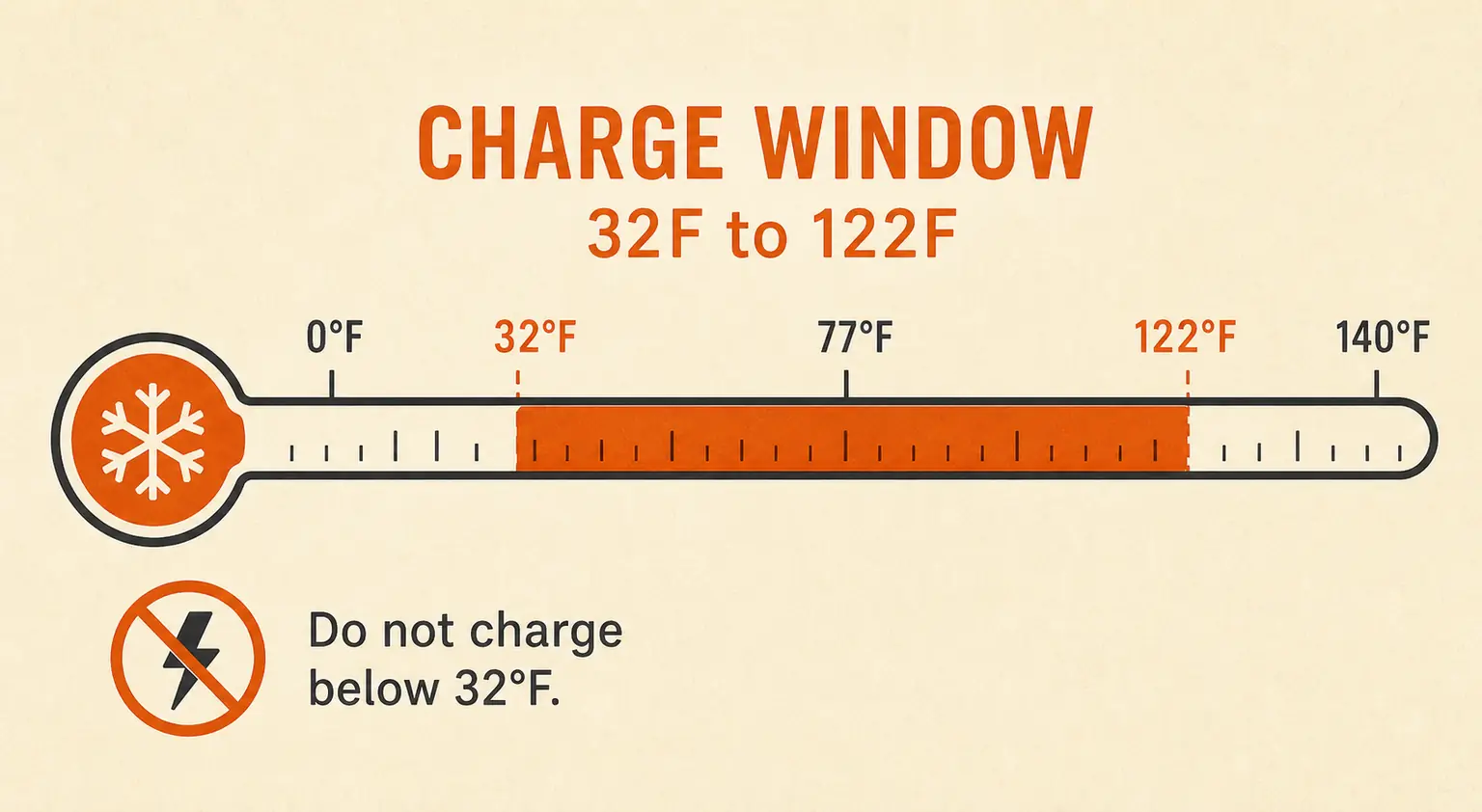
The cold-weather line. This base model charges only between 32°F and 122°F, and LiFePO4 charged below freezing is damaged by lithium plating — the manual’s own instruction is to bring it somewhere warm to charge in winter. If your battery lives outdoors in a cold climate, that’s not a footnote, it’s the deciding spec: you want the heated version or a different model with a built-in low-temp cutoff — the full options math is in our LiFePO4 cold-charging guide, and the side-by-side specs are in the brand comparison.
Who it’s for / Not for / Alternatives
Who it’s for: 12V storage builds whose continuous draw stays under ~90A per battery — RV house banks, cabin systems, solar storage sheds, CPAP/fridge backup — where the battery lives above freezing, the price-per-usable-Wh matters, and a 5-year warranty is the reassurance floor. It’s the battery our sizing math lands on most often, which is exactly why it’s the site’s most-linked model.
Not for: cold-climate banks that charge outdoors in winter (this base model has no low-temp protection — the heated version or the Renogy Core Mini with a built-in cutoff are the honest picks); engine starting (LiTime explicitly rates it for energy storage only); single-battery builds running 2,000W+ inverters (the 100A BMS ceiling — buy two or re-size); and monitoring-first builds that want phone-app state-of-charge without adding a shunt-based monitor.
Alternatives to consider: the Renogy Core Mini 12.8V 100Ah (more compact, built-in low-temp charge cutoff — per manufacturer spec) if cold protection or size matters more than price; the Redodo 12V 100Ah (Group 31, 4P4S-capable) on the budget end; and LiTime’s own self-heating 100Ah if you want to stay in the ecosystem and charge through freezing weather. All three sit in the 100Ah spec-math comparison with side-by-side numbers.
Warranty & durability
LiTime’s warranty policy (retrieved 2026-09-06) covers this battery — a 12V model ≥20Ah — for 5 years from the original consumer’s date of receipt, against defects in workmanship and material under normal consumer use. Repair is at LiTime’s expense; unrepairable units get a free same-or-equivalent-model replacement (replacements may be refurbished but functionally equivalent; repaired/replaced items carry a 90-day warranty or the remainder of the original, whichever is longer). Worth knowing: the policy publishes no capacity-retention threshold (no “X% after Y years” promise), coverage requires the original purchase receipt, it’s not transferable, and it’s void for misuse, out-of-spec use (charging below freezing qualifies — the product literature forbids it), unauthorized repair, or auction-site purchases. Warranty terms change — verify current terms on the manufacturer’s warranty page before purchase.
Known limits and failure modes
Only the documented ones, per the manufacturer’s own pages: charging below 32°F can permanently damage the cells and is outside the warranty’s normal-use terms; the BMS disconnects loads above 100A continuous (by design — that’s the protection working); and the 400A/1s surge window is too short to start large motors that need longer crank currents, which is part of why this is a storage battery, not a starter. We make no reliability claims beyond the published documentation.
Frequently Asked Questions
Did you test this battery?
Can one of these run a 2,000W inverter?
Can I charge it in freezing weather?
How many can I connect together?
What's the fastest I should charge it?
Next logical reads
LiFePO4 100Ah brand comparison (spec math) Best solar batteries 2026 (buyer guide) LiFePO4 vs lead-acid How long will a 100Ah battery run MPPT controllers to pair with it
12.8V, 1,280Wh, 100A continuous BMS with 400A/1s surge, IP65 case, and a 5-year warranty (per manufacturer spec). Not for: charging below freezing (no low-temp protection on this base model), engine starting, or single-battery 2,000W inverters — the 100A ceiling decides. The honest tradeoff: the value price buys no Bluetooth and no heater; both exist as separate versions.
Check price on Amazon (opens in a new tab) Price & availability shown on Amazon.com — we may earn a commission.