Quick answer
No — you cannot safely charge a LiFePO4 battery below 32°F (0°C), and doing so permanently damages it. Below freezing, lithium ions plate onto the graphite anode instead of intercalating into it (standard LiFePO4 electrochemistry — this is chemistry, not opinion). Plating is permanent capacity loss you can’t undo, and in the worst case it builds dendrites that can eventually short a cell. Discharging is different: it’s safe down to about −4°F (−20°C), with reduced capacity and output in the cold.
You have three honest fixes, in order of convenience:
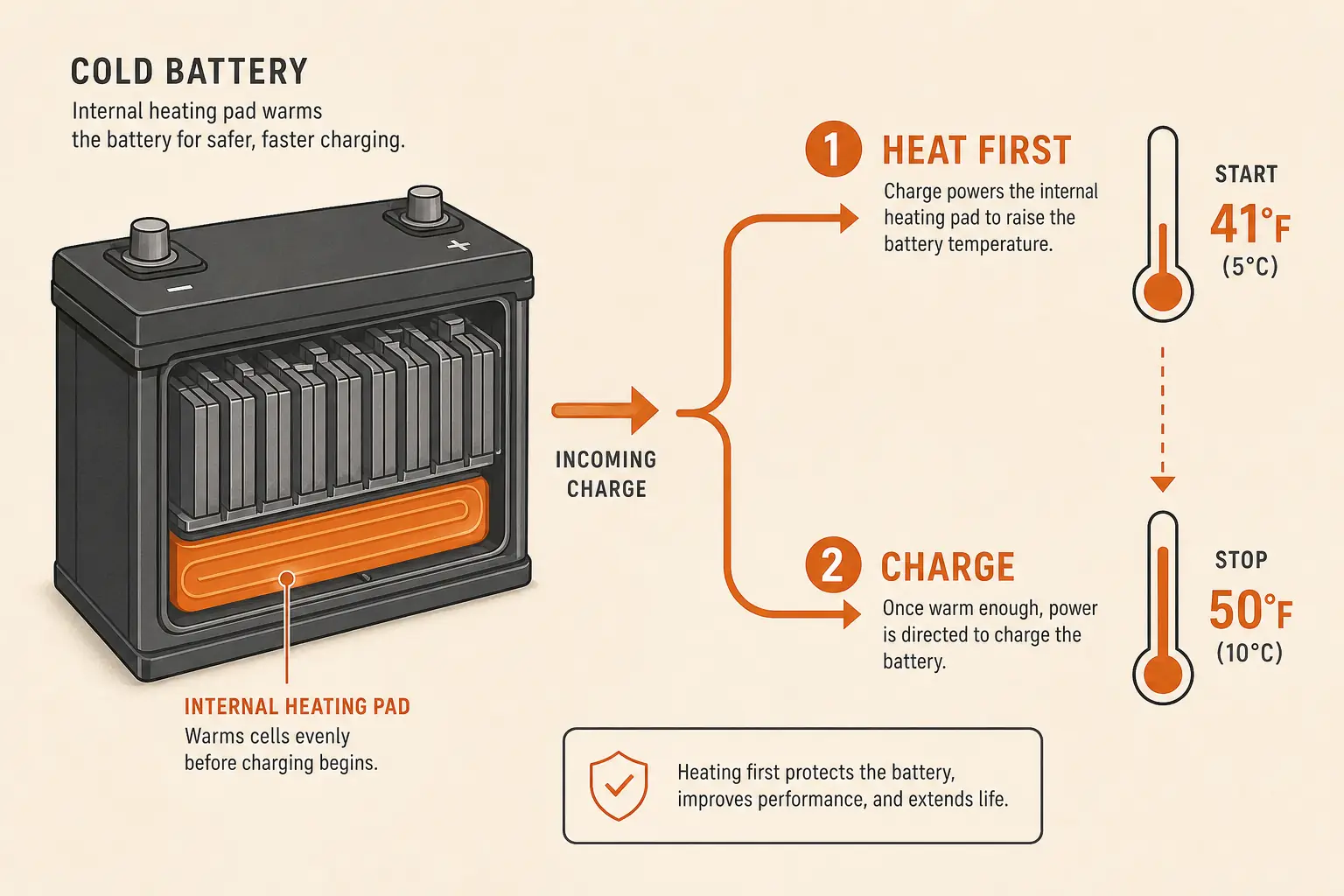
- Buy a self-heating battery — a BMS-controlled heating pad warms the cells before charging (verified examples below).
- Warm the bank you already own — thermostat-controlled heater pads and insulation.
- Charge only in the warm window — midday sun above freezing, and size for it.
If your battery lives outdoors in a climate that freezes and charges from solar, this is not a footnote — it is the winter spec. Here’s the full math.
What actually happens below 32°F
Charging a lithium cell means pushing lithium ions into the graphite anode. Above freezing the ions slip into the graphite structure. Below freezing the kinetics slow down and metallic lithium deposits on the anode surface instead — that’s lithium plating. The consequences, in plain terms:
- It’s permanent. Plated lithium doesn’t re-dissolve in normal cycling; you lose capacity for the life of the battery.
- It’s invisible in the moment. The battery accepts charge normally; there’s no warning light.
- It compounds. Repeated cold charging stacks damage — a “workshop battery” charged in an unheated garage all winter can lose a large share of its capacity by spring.
- Worst case, it’s a safety issue. Severe plating can grow dendrites that pierce the separator. That’s why BMS-level protection exists.
This is standard lithium-iron-phosphate electrochemistry, which is why every reputable manufacturer publishes a charge temperature floor of 32°F/0°C — check any LiFePO4 datasheet. None of it is our testing; it’s the chemistry the whole industry designs around.
Why discharging is fine but charging isn’t
Discharging below freezing is safe (most LiFePO4 cells are rated to −4°F/−20°C) because lithium leaves the anode acceptably in the cold — you just get less: expect noticeably reduced usable capacity and lower current delivery as temperatures drop, recovering when the pack warms. Charging is the forbidden direction, because that’s when plating occurs. So your bank can power the cabin all night at 20°F; it just can’t refill until it’s warm.
What a low-temp cutoff actually does
Many modern LiFePO4 batteries (base models included) have a low-temperature charge cutoff: a BMS temperature sensor that simply refuses charge current below ~32°F and re-enables it once the pack warms past roughly 41°F (5°C). For example, LiTime’s spec pages describe automatic charge shutoff below 32°F/0°C with recovery at ≥41°F/5°C (per manufacturer documentation, retrieved 2026-09-06).
Know what you’re buying: a cutoff protects the battery by sacrificing the charging. On a freezing sunny day, a cutoff-equipped battery charges nothing — the panels make power, the BMS declines it. If your winter plan depends on solar recharge, protection alone isn’t a plan. That’s what self-heating is for.
Option 1: self-heating batteries (the integrated fix)
A self-heating battery diverts incoming charge power to heating pads until the cells are warm enough to charge. Two verified examples of how differently brands implement the same idea:
| Spec | LiTime 12V 100Ah Group 24 self-heating | Redodo 12V 100Ah self-heating |
|---|---|---|
| Heating activates | BMS triggers when charging at −4°F to 41°F (−20°C to 5°C) | Below 32°F/0°C when connected to power |
| Heating stops at | 50°F (10°C) | 41°F (5°C) per feature copy; the brand’s FAQ says 10°C — published discrepancy, treat 5°C as the floor |
| Heater power | 100W dual pads | 100W dual pads |
| Warm-up time | 70–90 min from 14°F; 100–150 min from −4°F | 30–60 min from 14°F; 70–100 min from −4°F |
| Minimum charge current to run heater | 10A | 15A |
| Charge range | −4°F to 122°F | −4°F to 122°F |
| BMS | 100A continuous, 500A/1s peak | 100A continuous, 500A surge |
| Extras | Bluetooth app: SOC, temperature, heating mode, remote off | — |
| Size / weight | Group 24, 22.71 lbs | Group 31 footprint, 23.32 lbs |
| Warranty | 5 years | 5 years |
Both columns per manufacturer documentation, retrieved 2026-09-06. Neither battery was tested by us.
The heater math you should run before buying. The heater draws from your charge source, and it’s not free:
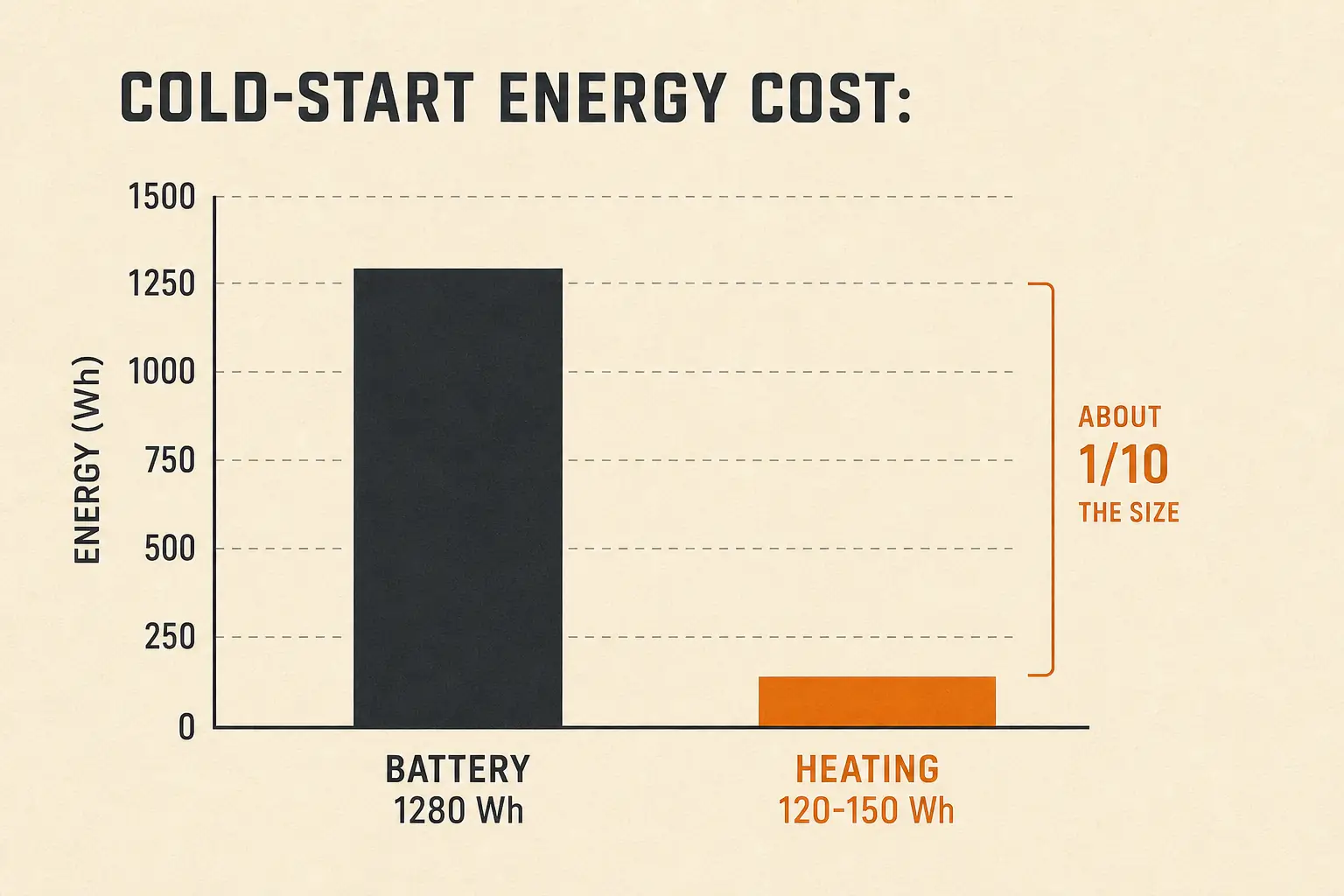
- Energy cost per cold start: 100W × 70–90 min ≈ 120–150Wh to warm from 14°F before charging begins — roughly 10% of a 1,280Wh battery spent on heat, plus the same again on very cold (−4°F) mornings at 100–150 min. Budget winter harvest accordingly.
Option 2: warm the bank you already own
If replacing batteries isn’t in the budget, external warmth does the same job with more assembly:
- Thermostat-controlled 12V heater pads — the RV world’s tank-heater pads (designed to keep holding tanks from freezing, on around 45°F and off around 68°F per their listings) are what many off-gridders mount under or beside battery boxes. Two honest cautions: these are tank products, not battery products — sizing and mounting are on you — and they draw continuous power while on (budget them like a winter load), so thermostat control is non-negotiable. Facon 12V heater pads with built-in thermostat (2-pack) (opens in a new tab) are the common example of the class (specs per manufacturer listing, retrieved 2026-09-06).
- Insulation without smothering. An insulated enclosure holds the day’s warmth into the night — see our battery enclosure guide for venting and chemistry rules. Insulation alone can carry a bank through a mild freezing night using heat from the previous day’s charging.
- The honest simple option: bring it inside. Small portable banks (CPAP batteries, single 100Ah units) can simply move indoors to charge. It’s free, and it’s what LiTime’s own FAQ recommends for its non-heated models. Not elegant for a 400Ah fixed bank — exactly the situation heated batteries exist for.
Option 3: charge-window discipline
The zero-hardware option: only charge when the battery is above 32°F.
- Midday charging: even cold climates often break freezing between late morning and mid-afternoon. An insulated battery box that rides above 32°F for 3–4 hours charges meaningfully in that window.
- Size for the short window: winter sun is low and brief — check your location in our peak sun hours by state tables and plan on roughly half your summer figures for a fixed-tilt array in midwinter (typical continental-US pattern; verify your site’s numbers).
- Cutoff-equipped batteries do this automatically — they decline the charge when cold and accept it when warm, so the “discipline” is really array sizing: enough panel to fill the usable window.
A worked winter morning
Two 100Ah LiFePO4 batteries (non-heated, cutoff-equipped) in an insulated box, 400W of panel, a cold-snap day peaking at 28°F outside but ~38°F in the sun-warmed box after noon: the BMS permits charging from roughly noon–3pm. At winter irradiance the 400W array delivers maybe 250W average in that window → ~750Wh in — about 30% of the bank’s 2,560Wh. Fine for a light-load cabin; not fine if you’re burning 800Wh a night. That gap is the honest case for a heated model or a generator top-up — the numbers decide, not the marketing.
Safety notes
Never fast-charge a battery that was below freezing and has only partially warmed — the surface can read warm while the cells lag. Never wrap a battery in household insulation against a high-wattage heater with no thermostat. And don’t try to heat your way past the upper charge limit either: charging above 122°F does its own damage. If you want the full seasonal checklist — panels, wiring, enclosures, monitors — it’s in our winterizing guide.
Frequently Asked Questions
Can I charge my LiFePO4 battery at 30°F just for a little while?
Does using (discharging) my LiFePO4 battery in freezing weather damage it?
How much of my solar power does a self-heating battery waste?
Budget 120–150Wh per cold start from 14°F, roughly 10% of a 100Ah battery’s capacity — more on sub-zero mornings (100–150 minutes of 100W heating, per manufacturer documentation retrieved 2026-09-06). Insulated placement reduces the number and length of heating cycles.
Will my 100W panel run a self-heating battery in winter?
Can I add a heater pad to any LiFePO4 battery?
Next logical reads
Winterizing your off-grid system (full checklist) LiTime 12V 100Ah review (the non-heated base model) LiFePO4 100Ah brand comparison Peak sun hours by state Battery enclosure guide
BMS-controlled 100W dual heating pads warm the cells whenever charging happens between −4°F and 41°F, stopping at 50°F; charges down to −4°F, 100A BMS, Bluetooth app with temperature and heating-mode control (per manufacturer spec, retrieved 2026-09-06). Not for: banks that never see freezing temperatures — the base 100Ah costs less and does the same job (see our LiTime review). The honest tradeoff: each cold start spends 120–150Wh of your winter harvest on heat, and the heater needs ≥10A of charge current to run.
Check price on Amazon (opens in a new tab) Price & availability shown on Amazon.com — we may earn a commission.