The honest answer up front Before you start: safety and setup Test 1: open-circuit voltage (Voc) Test 2: short-circuit current (Isc) Reading the results Common failures and their signatures FAQ
The honest answer up front
You only need two measurements to judge almost any solar panel: open-circuit voltage (Voc) — is the panel producing any voltage at all — and short-circuit current (Isc) — can it deliver electrons. A $30 multimeter and five minutes tell you more than a week of guessing.
Expect the results to be below the label: a panel in real conditions typically produces Voc close to spec in good sun, and Isc at 70–90% of spec depending on angle, season, and weather. That’s physics, not a defect. What indicates a real problem: Voc at zero (dead panel or wiring), Voc far below spec (failed bypass diode or cracked cells), or Isc near zero in full sun with healthy Voc (broken series string inside the panel).
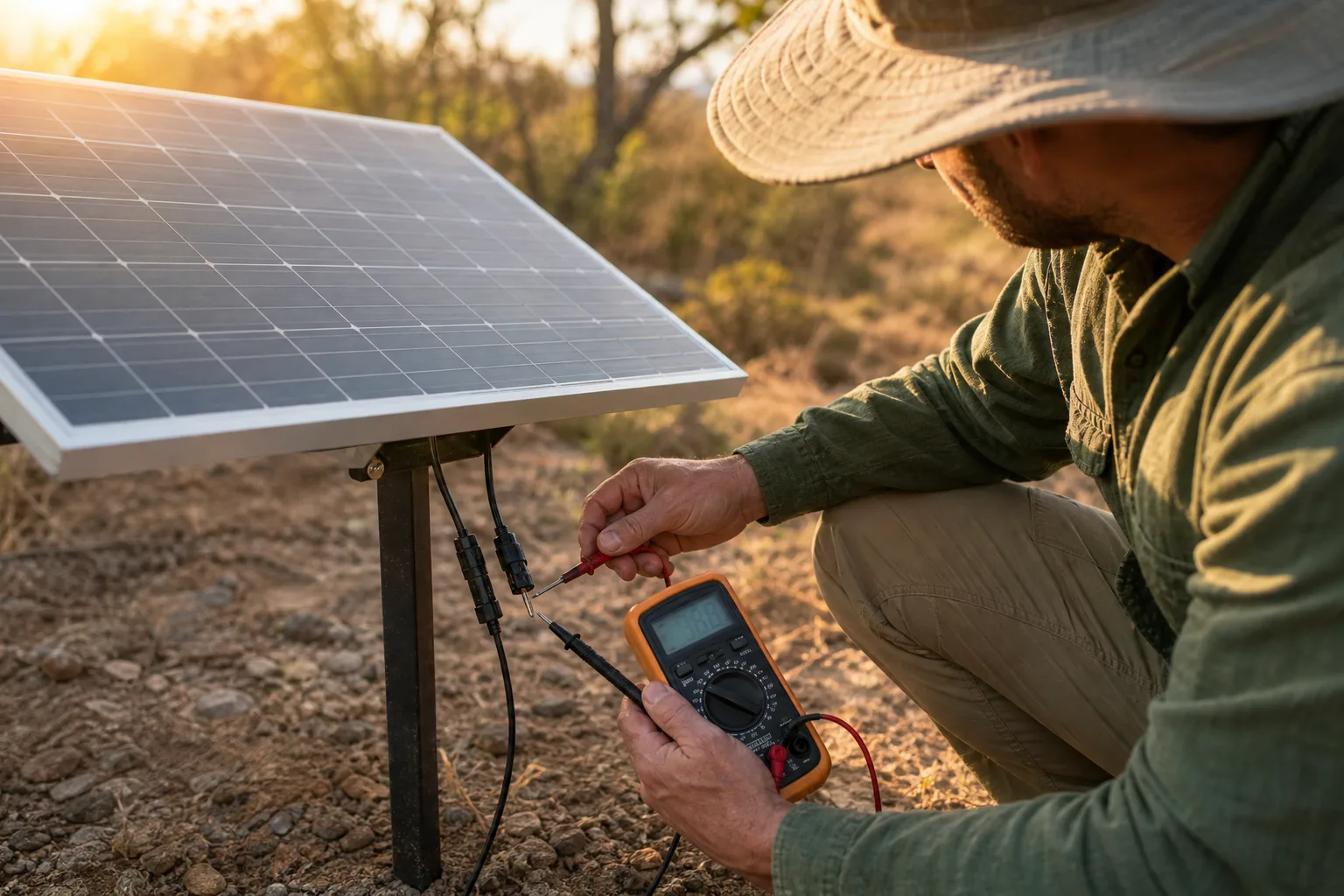
Before you start: safety and setup
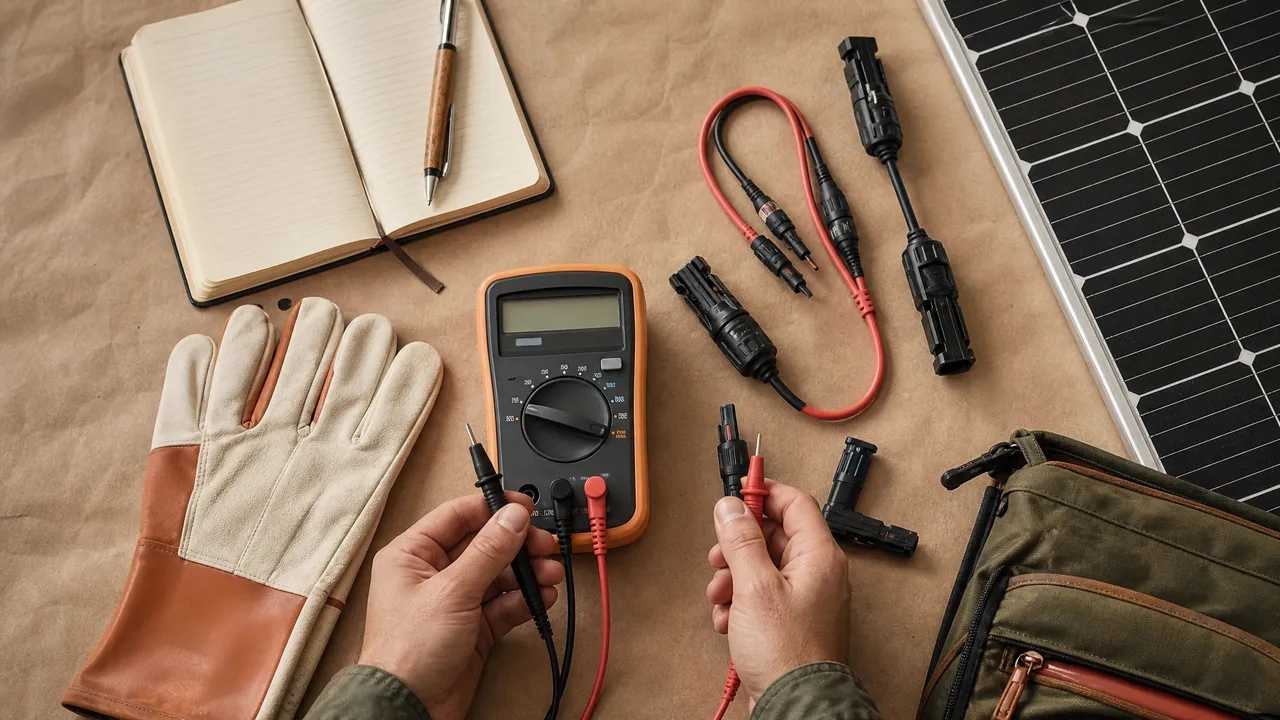
- Meter ratings matter. Panel strings can present voltages above what a basic meter is rated for. For single 12V-panel testing, any DMM works; for series strings above ~60V, use a meter rated CAT III 600V. If you don’t know what that means, that’s the sign to read the manual before the panel.
- Disconnect the panel from the charge controller for the voltage test — you’re measuring the panel alone, not the system.
- Never short a panel through household wire or screwdrivers to “test” it. The multimeter’s current mode is designed for brief Isc checks; a wrench across the terminals is designed for the emergency room.
- Pick real sun. Both tests assume the panel is face-up in clear sunlight. Overcast skies can cut Isc by 80%+ and make a healthy panel look dead.
- Have the spec sheet or the label photo handy. Voc and Isc are printed on the back of nearly every panel — you’ll compare your readings against them.
Test 1: open-circuit voltage (Voc)
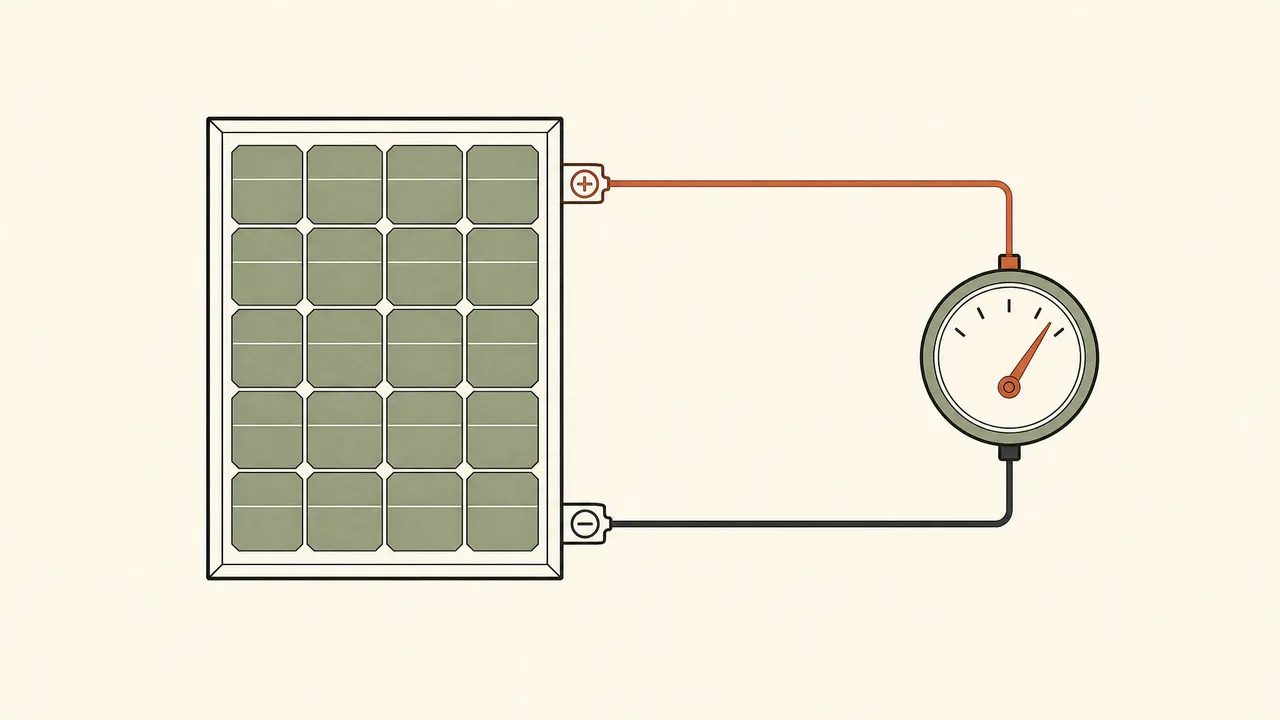
Open-circuit means the panel connects to nothing but the meter — no controller, no battery, no load.
Procedure:
- Set the multimeter to DC voltage (V⎓) on a range above the panel’s rated Voc (a 100W 12V panel is typically ~18–22V — the 200V range is fine).
- Disconnect the panel from everything.
- Touch the red probe to the panel’s positive lead (or MC4 adapter) and the black probe to negative.
- Read the display immediately.
What it means:
| Reading vs. spec label | Likely meaning |
|---|---|
| Within ~10% of rated Voc | Panel voltage circuit is healthy |
| 0V | Dead panel, broken lead, or failed internal series connection |
| 40–70% of rated Voc | One section dead — classic failed bypass diode signature |
| Slightly above spec in cold weather | Normal — Voc rises as temperature drops |
A panel that passes Voc is half-proven: voltage is easy to make, current is where cracked cells and degraded solder joints show up. That’s what Test 2 is for.
Test 2: short-circuit current (Isc)
Short-circuit current measures the maximum current the panel can push when it has zero resistance in its path — and the multimeter in current mode is exactly that (briefly, by design).
Procedure:
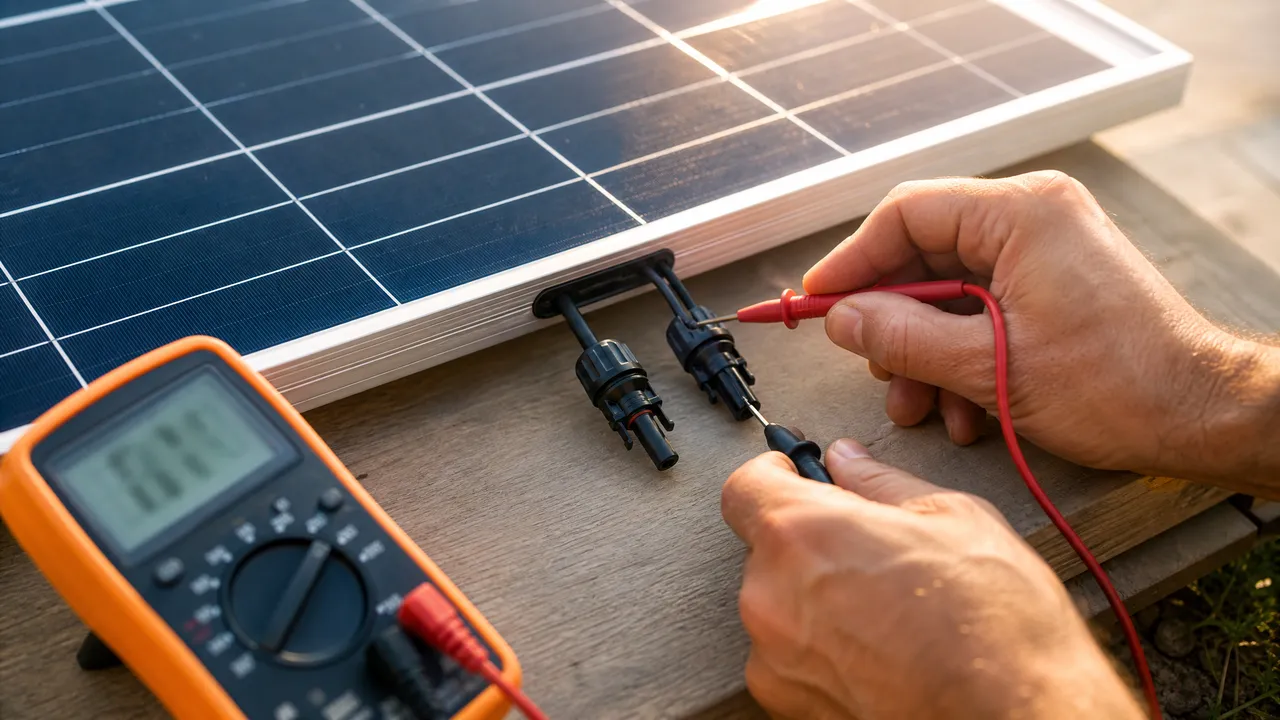
- Set the meter to DC current (A⎓). If your meter has separate sockets for high current (typically 10A), move the red lead there. Check the panel’s rated Isc first — a 100W panel is usually 5–6A, well within a 10A socket.
- With the panel in full sun, touch red to positive, black to negative for a few seconds and note the reading.
- Don’t hold it long — the meter shunt heats. A few seconds is plenty for a stable number.
What it means:
- 70–100% of rated Isc in good sun: healthy. Angle, temperature, and haze eat the missing fraction.
- 0A with healthy Voc: the panel’s internal series circuit is broken — cracked cell, failed joint. Panel is done.
- Far below expectations on a clear noon: shade the panel section by section with cardboard and watch the meter — a sudden step-change when you cover one area points to a localized fault (and shows your bypass diodes working).
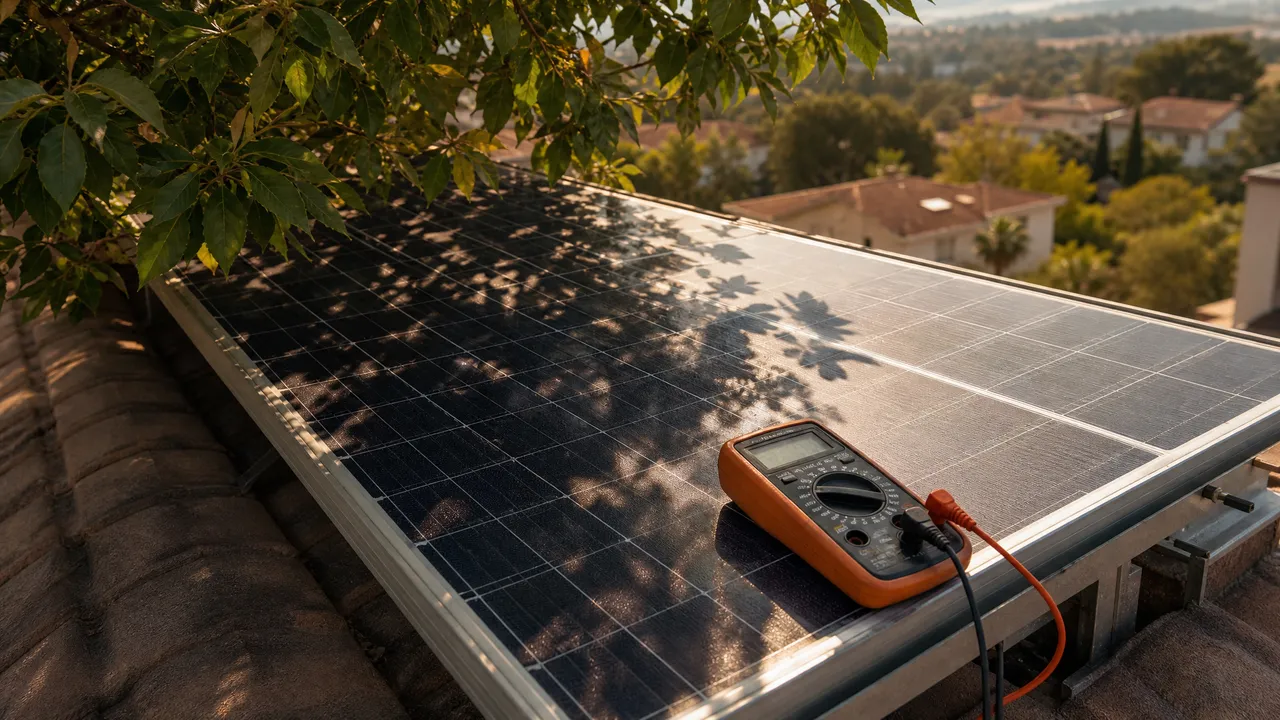
If the panel is staying on the roof, compare against expectations honestly: a winter sun angle can legitimately halve Isc. Track against our solar panel output reference for what a given month should give before condemning hardware.
Reading the results: what normal looks like
A healthy panel in decent conditions:
- Voc: within 10% of the label (slightly over in cold, slightly under in heat)
- Isc: 70–90% of the label at a typical install angle, in clear mid-day sun
The diagnostic matrix:
| Voc | Isc | Verdict |
|---|---|---|
| Good | Good | Panel is fine — problem is elsewhere (controller, wiring, battery) |
| Good | Zero/low | Internal series failure or cracked cells — replace panel |
| Low (40–70%) | Anything | Suspect failed bypass diode — confirm before replacing |
| Zero | Zero | Dead panel, or broken/disconnected leads — wiggle-test the cables first |
For the “problem is elsewhere” verdict, continue with the low solar output troubleshooting checklist, which walks the controller and wiring side of the system.
Common panel failures and their signatures
- Failed bypass diode: Voc drops to a fraction of spec because one series section is shorted out by the failed diode. Common after lightning nearby or long shade + heat.
- Cracked cells: Voc normal, Isc low and erratic — output changes when you press lightly on the panel face. Micro-cracks from shipping or hail grow over seasons.
- Corroded connections: both readings sag, especially in marine or roadside installs. Cleaning MC4 contacts sometimes resurrects a “dead” panel.
- Delamination/moisture: visible fogging or pattern lines; output decays over months. Not fixable.
- Plain dirt: the most common “fault” of all. Isc recovers after cleaning — measure before and after to know what your soiling loss actually is.
Both Voc and Isc checks are within this meter's DC voltage and 10A current ranges for typical 12V/24V panels, and the CAT III 600V rating covers series strings safely (per manufacturer spec). Not for: probing inside combiner boxes on high-voltage string systems — that's licensed-electrician territory. The honest tradeoff: it's manual-ranging, so you set the scale yourself — which is also why it survives the kind of abuse a solar toolkit dishes out.
Check price on Amazon (opens in a new tab) Price & availability shown on Amazon.com — we may earn a commission.FAQ
Can I test a solar panel without disconnecting it?
Why is my Isc lower than the panel's rating?
Is it dangerous to short a solar panel with a multimeter?
What range should the multimeter be set to?
My panel passes both tests but the battery still isn't charging.
Next logical reads
Low solar output troubleshooting Solar panel output expectations How to read a solar panel spec sheet Solar battery not charging checklist MPPT controller not charging Solar panel degradation over time