The honest answer up front Key takeaways What series wiring actually does What parallel wiring actually does Series-parallel hybrid banks The cable and fusing rules that keep it safe Balancing: why banks age unevenly FAQ
The honest answer up front
Series wiring adds voltage; parallel wiring adds capacity (amp-hours). Two 12V 100Ah batteries in series make a 24V 100Ah bank. The same two in parallel make a 12V 200Ah bank. Same batteries, same stored energy — different voltage, different current, different cable sizes.
Which one you want is not really a battery decision. It’s a system decision: your inverter input range and charge controller limits usually pick the voltage for you (see 12V vs 24V vs 48V solar systems). Once the voltage is chosen, the wiring follows.
Where people get hurt is the details, not the concept. The three failure patterns we see over and over: mismatched batteries mixed into one bank, parallel banks without per-string fusing, and cable runs of different lengths letting one battery do all the work. All three are covered below.
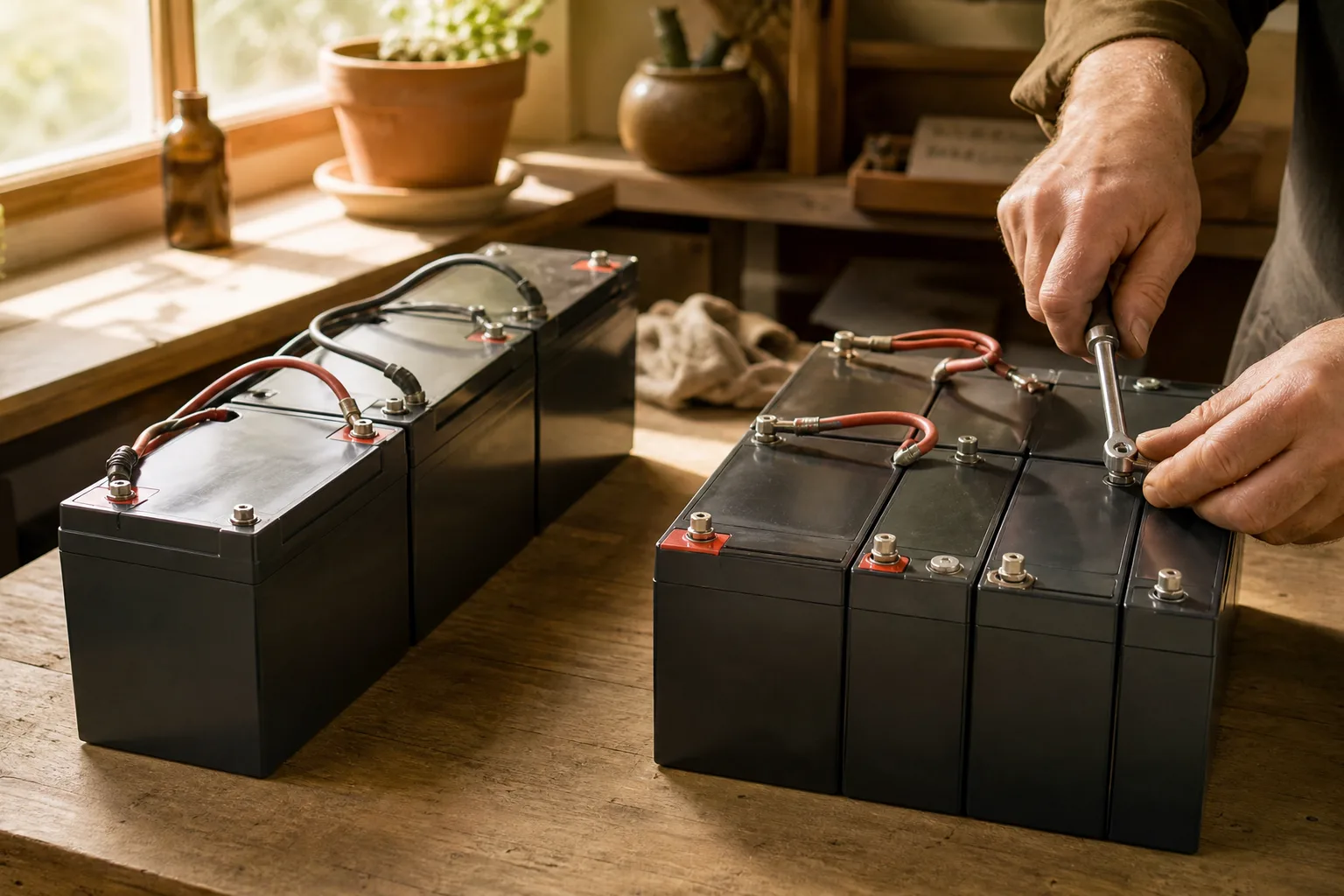
Key takeaways
- Series: voltages add, amp-hours stay, current stays low — thinner cable, but every battery must match.
- Parallel: amp-hours add, voltage stays — simple, but higher total current demands heavier cable and per-string fusing.
- Never mix different capacities, ages, or chemistries in one bank — the weakest battery sets the limit for all.
- LiFePO4 with built-in BMS tolerates both configurations, but series strings need batteries of the same brand/capacity and ideally the same firmware behavior.
- Fuse the bank, not just the inverter: every parallel string should be individually protected so one short can’t dump the whole bank into it.
What series wiring actually does
In series you connect the positive of one battery to the negative of the next, and take power from the two remaining end terminals.
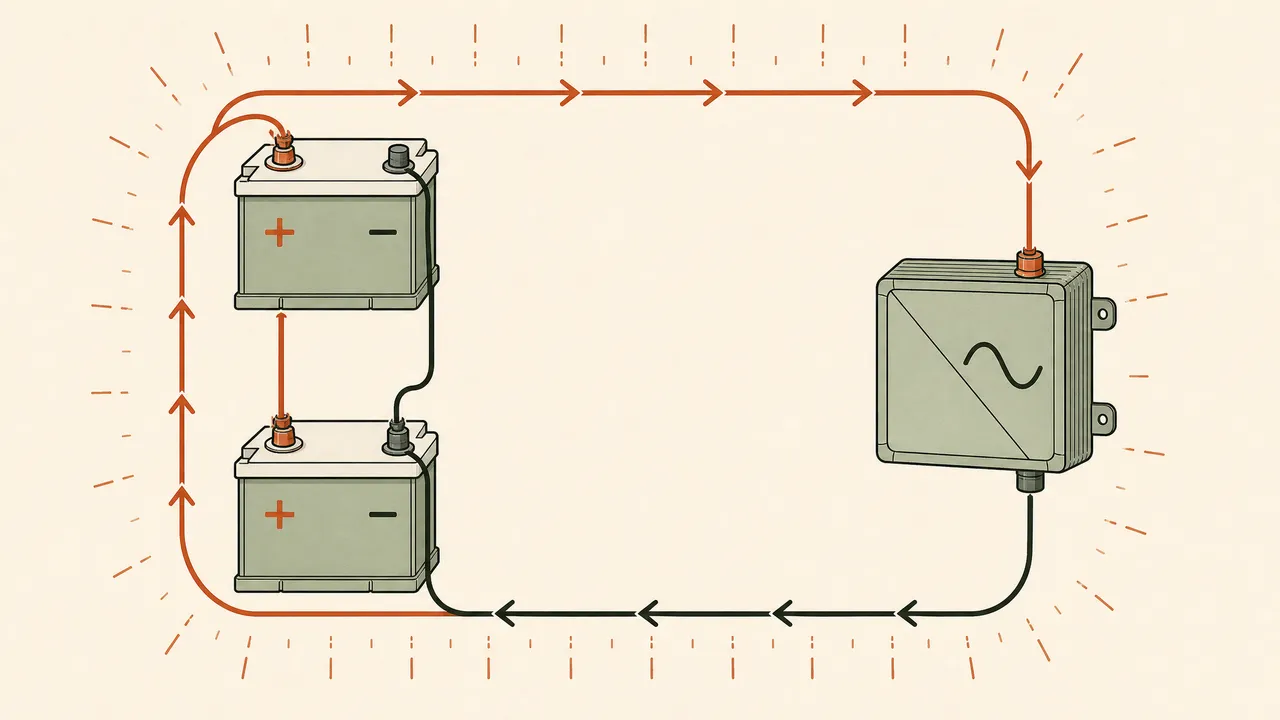
What that buys you:
- Higher system voltage for the same stored energy. A 24V bank moving 1,000W draws ~42A instead of ~83A at 12V — roughly a quarter of the resistive loss for the same cable, or the same loss with much lighter cable.
- The same current flows through every battery. There’s no “sharing” problem inside a series string — whatever goes in one terminal comes out the other. Charging is inherently balanced in the sense that all cells receive identical amp-hours.
- Fewer parallel paths to fuse. A 24V 200Ah bank from two 12V 100Ah batteries in series needs one overcurrent device, not two.
The tradeoffs:
- One weak battery drags the whole string. In series, a battery that has less capacity becomes the first to empty and the first to over-charge on the other end. The BMS in a lithium battery will disconnect to protect itself — which disconnects the whole string.
- You must match batteries. Same model, same capacity, same age class. Not “both are 100Ah” — same part number ideally.
- Terminal voltages stack. Two 12V batteries in series float around 27V; make sure every connected device (inverter, DC appliances, charger) is rated for the stack, not the single battery.
Safety note: the connection between batteries in a series string is not at system voltage — each interconnect floats at an intermediate potential. Treat every terminal as live, because relative to ground it may be.
What parallel wiring actually does
In parallel you join positive to positive and negative to negative — usually through bus bars rather than daisy-chained terminals.
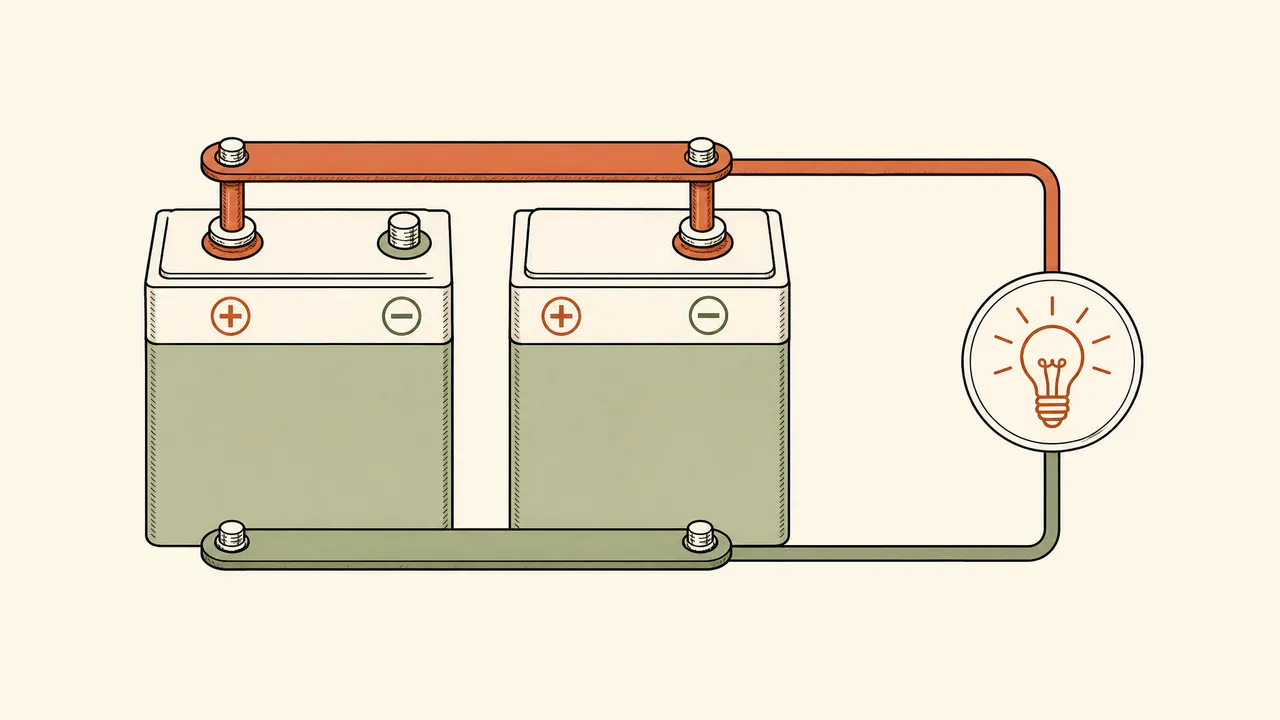
What that buys you:
- Capacity without changing system voltage. Ideal when your inverter, charge controller, and DC loads are all 12V and you just need more amp-hours.
- Redundancy of a sort. One battery failing open doesn’t take the bank down (though one failing short is exactly what fusing is for).
- Simpler mental math for 12V upgrades — an RV or van system that started with one battery and grows.
The tradeoffs are the reason parallel gets a bad reputation:
- Current sharing is not automatic. Batteries at slightly different voltages or connected by cables of different lengths contribute unequal current. The one closest to the load (or with the shortest, fattest cable) works hardest, ages fastest, and drags the others down with it.
- Total fault current stacks. Two parallel 100Ah batteries can deliver their combined short-circuit current into a fault — per-string fusing is not optional at any size worth building.
- Lead-acid parallel banks need periodic equalization attention that series strings largely sidestep; mixed-age parallel lead-acid banks are the classic self-discharge loop.
The wiring pattern that fixes sharing: run each battery’s positive and negative to a common bus bar pair with equal-length cables, instead of chaining battery-to-battery. This geometric symmetry does more for bank longevity than any gadget.
Series-parallel hybrid banks
Bigger banks do both: for example, four 12V 100Ah batteries as two series strings of two (24V each), paralleled into a 24V 200Ah bank. Hybrid banks inherit both rules:
- Each series string must be matched batteries.
- Each parallel string must have its own fuse or breaker between string and bus.
- String voltages must match before paralleling — connect a 26.0V string to a 25.4V string and the bank equalizes through your wrench, not gently.
For lithium, most manufacturers publish a maximum number of parallel units (often 4) and require the same model across the bank. That document beats any general rule on this page — including ours.
The cable and fusing rules that keep it safe
Wiring a bank safely reduces to three decisions, all covered in depth elsewhere on this site:
- Cable size follows current, not battery count. A 12V parallel bank feeding a 2,000W inverter pulls ~170A continuous and needs 2/0 AWG or heavier — the full math is in battery cable size for solar inverters.
- Every parallel string gets its own overcurrent device rated to protect the smallest conductor in that string. Sizing logic lives in solar fuse and breaker sizing.
- Equal-length cables to a bus bar — within a few percent of each other. If you have one 2-foot cable and one 6-foot cable to the same bus, the short one carries the load alone.
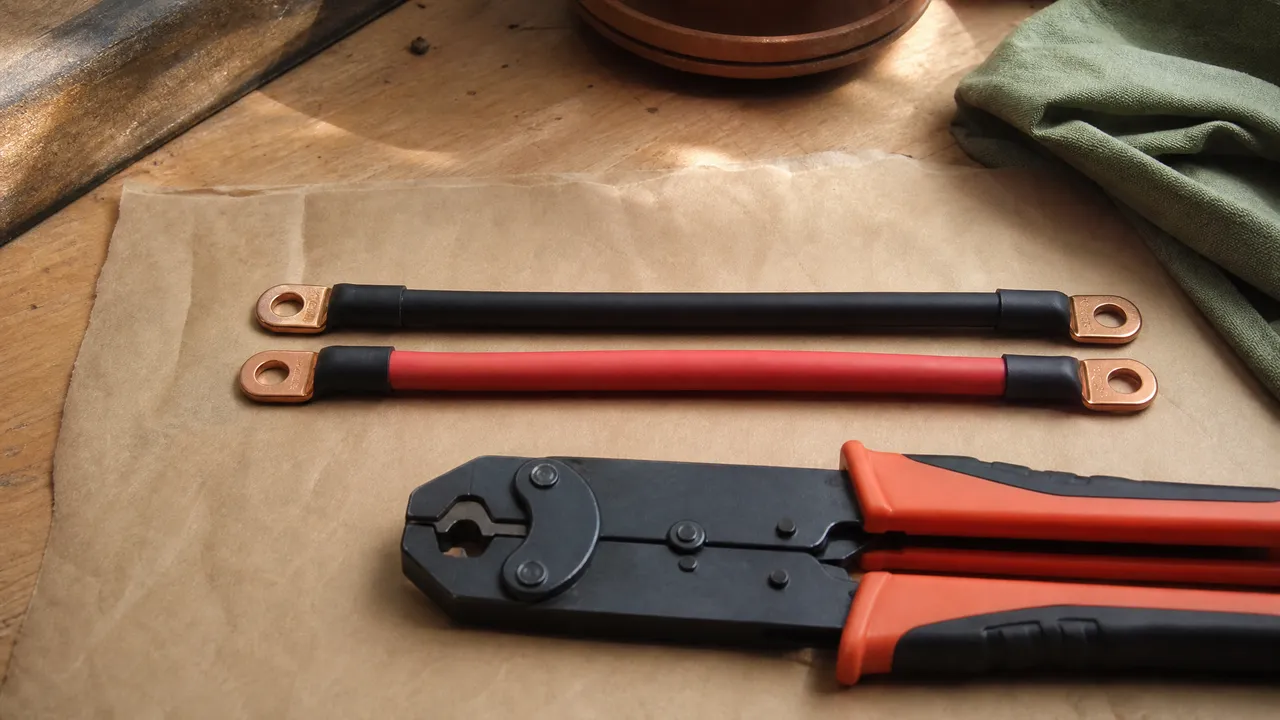
Torque matters as much as gauge. A loose lug at 170A is a space heater. Use a calibrated torque wrench on battery terminals and check them after the first month of service — copper creeps, connections relax.
Balancing: why banks age unevenly
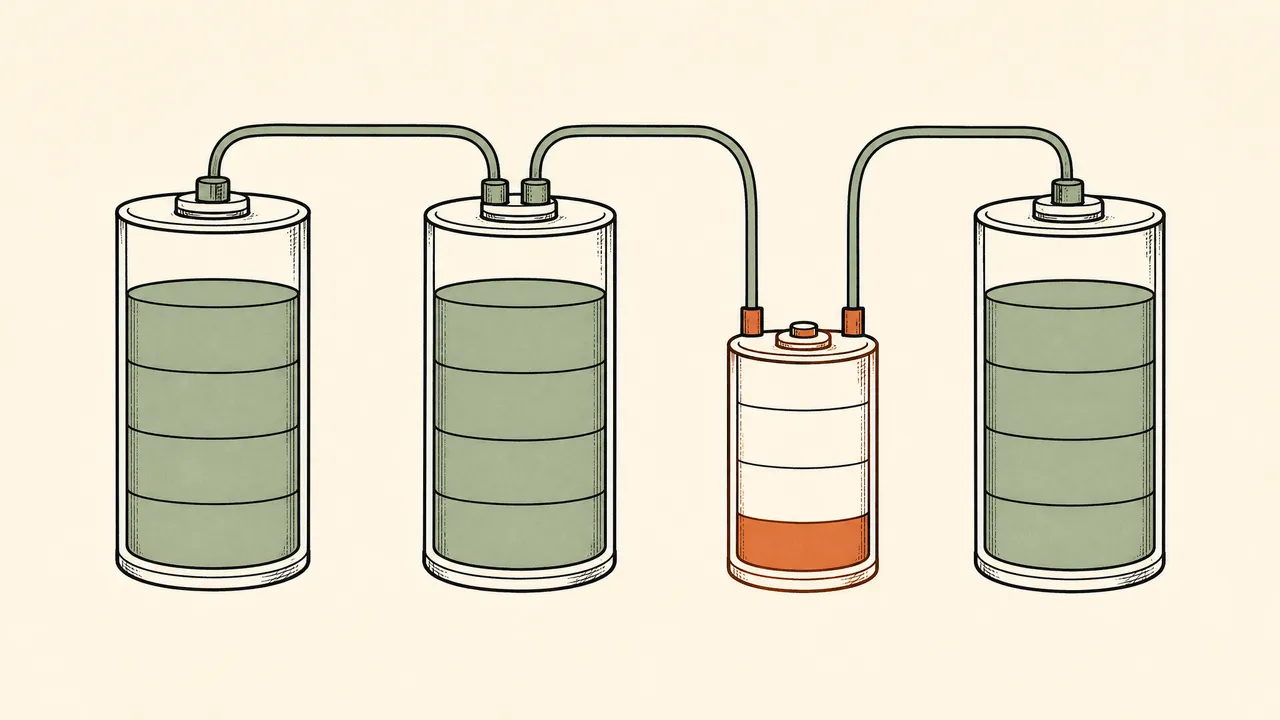
A series string is a chain: the lowest-capacity battery defines the pack. It fills first on charge, empties first on discharge, and its BMS (or in lead-acid, its weakest cell) hits limits before the others have done their share. Over months, that battery cycles deeper than its neighbors and ages faster — which makes it even weaker next season.
Practical defenses:
- Start matched, stay matched. Adding a new battery to an old bank means the new one immediately becomes the limiter in reverse — the old batteries age the new one down to their level.
- Watch resting voltages individually. On a healthy bank, individual battery voltages after a rest period should sit within ~0.1V of each other (12V lead-acid) or tighter for lithium. A battery that consistently reads different is telling you something.
- For lithium, let the BMS work but don’t lean on it. A BMS disconnecting to protect one battery is protection, not balancing — recurring disconnects mean the bank is mismatched or the charger profile is wrong for it (see LiFePO4 low-voltage cutoff settings).
- Temperature parity. The battery nearest the inverter or heat source ages differently. Even a few degrees of consistent difference compounds.
Balancing starts with data: a shunt-based monitor measures what goes in and out of the whole bank, and with the optional temp sensor you can catch a battery that behaves differently season to season (per manufacturer spec). Not for: per-battery diagnosis in a series string — the shunt sees the bank, not each unit; a clamp meter and monthly voltage checks still do that. The honest tradeoff: it is one more wired component to install, and if you only have a single battery, your multimeter already tells you everything it would.
Check price on Amazon (opens in a new tab) Price & availability shown on Amazon.com — we may earn a commission.Equal-length, properly crimped lugs are the core of a balanced parallel bank — this hex crimper covers 12 AWG to 2/0 with matching dies (per manufacturer spec). Not for: 4/0 cable (die set tops out at 2/0 — check your inverter math first). The honest tradeoff: it's a specialty tool you'll use a handful of times; renting or borrowing one is legitimate for a one-shot build.
Check price on Amazon (opens in a new tab) Price & availability shown on Amazon.com — we may earn a commission.FAQ
Can I mix a 100Ah and a 200Ah battery in parallel?
Do I get more power from batteries in series or parallel?
Is series or parallel safer for lithium batteries?
Why did one battery in my bank die first?
Can I add more batteries to my bank later?
Next logical reads
12V vs 24V vs 48V solar systems Battery cable size for inverters How to choose system voltage Solar fuse and breaker sizing Li-ion vs lead-acid Solar battery maintenance LiFePO4 low-voltage cutoff settings