Quick answer String arithmetic The headroom rule Fuses and busbars The 2/4/8 table Grounding and disconnects FAQ
Quick answer
Scaling from one panel to many is two sums and one rule. The sums: series adds voltage (current stays), parallel adds current (voltage stays) — the fundamentals guide has the diagrams. The rule: keep the string’s cold-day open-circuit voltage at least 15% under your controller’s PV input limit — panels make more voltage in cold, and exceeding the limit is one of the few ways to actually destroy a controller. Match panels within strings (salvage: same current class), fuse every parallel string, and land everything on a busbar with a real disconnect. Four matched salvage panels on a 100V/30A-class controller is a ~1.6kWh/day microgrid — the working heart of a Tier-2 system.
String arithmetic
Planning numbers for the common salvage unit — a “12V nominal” 100W panel: Vmp ≈ 18V, Imp ≈ 5.5A, Voc ≈ 21V, Isc ≈ 6A (always use your panel’s label; how to read it).
- Series string of 3: voltages add → Vmp 54V, Voc 63V; current stays 5.5A. Power: 54 × 5.5 ≈ 300W. Voltage is high enough to keep wire losses low over a long run — wire size math.
- Parallel strings of 2: currents add → Imp 11A at 18V. Power: ~200W at 12V-class voltage, cheaper controller class but thicker copper.
- Series-parallel (2S2P): two series strings (36V, 5.5A each) in parallel → 36V, 11A, ~400W. The standard layout for 4-panel builds: comfortable voltage, moderate current, and each string is separately fused.
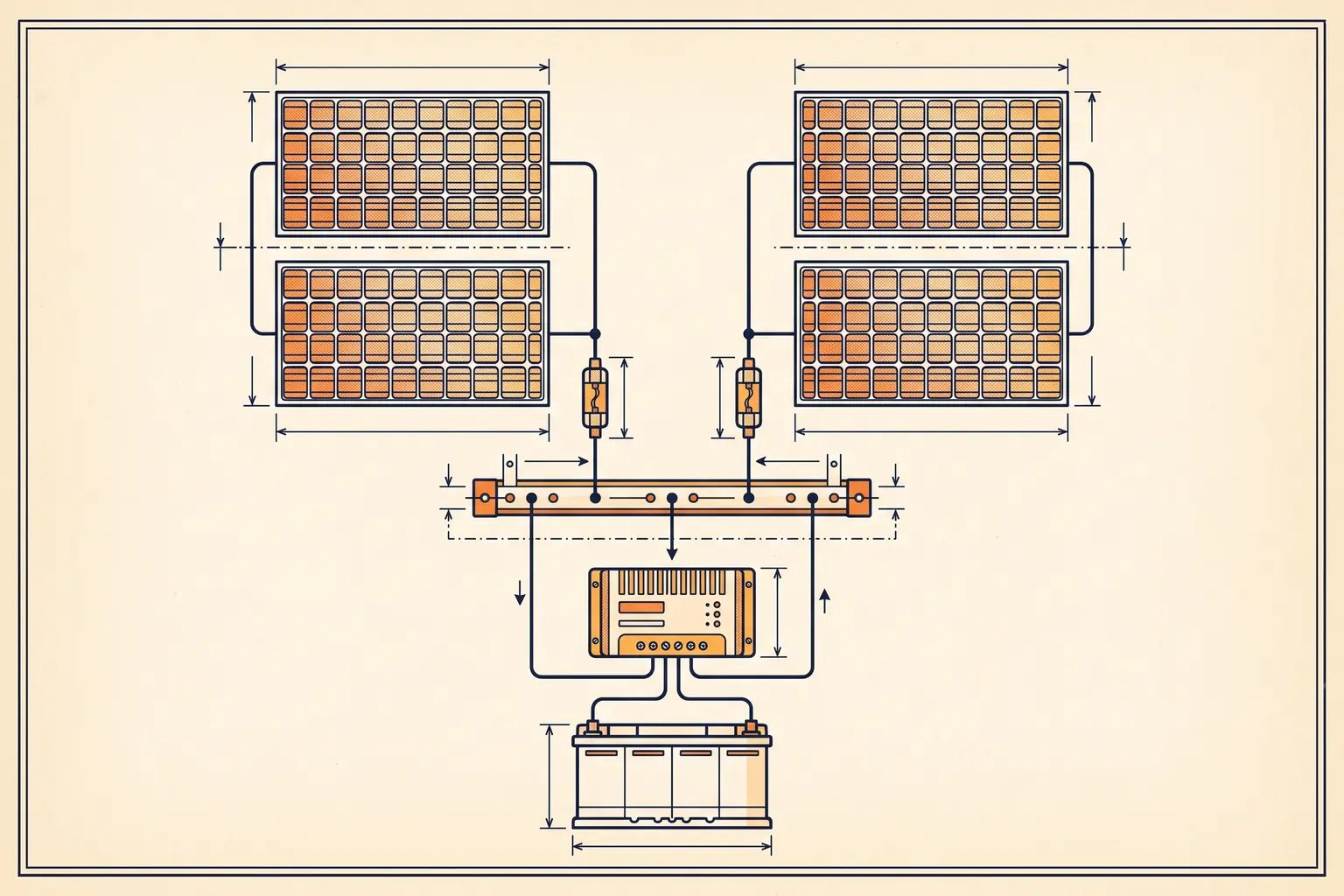
Mismatch warning carried over from the salvage guide: within a series string, panels should share a current class (the weakest panel sets the string’s current); between parallel strings, voltage classes should match. Mixed salvage works — but sort it before wiring, not after wondering why the harvest is low.
The headroom rule
Controller PV limits are hard ceilings. A “100V” model means 100V of PV input, ever — not “100V at room temperature.” Panel Voc rises as temperature falls (the coefficient is on the label, typically a small negative number per °C); a cold clear dawn is when your string hits its maximum.
Worked example, 100V-class controller (e.g., the Victron 100/30, 100V input per manufacturer spec):
- 3× in series: 3 × 21V = 63V nominal Voc. Cold margin: 63 × 1.15 ≈ 72V — comfortable.
- 4× in series: 84V nominal. Cold: 84 × 1.15 ≈ 97V — technically under 100V, but a hard-freeze morning with a worse-than-average coefficient brushes the limit. Verdict: 4S on a 100V controller is climate-dependent; the honest build is 2S2P instead, or step to a 150V-class controller.
- The rule of thumb: plan string Voc at +15% for cold, and stop at ~90% of the controller’s limit. If the math is close, change the layout — a controller that dies takes the harvest of every panel behind it.
Current has its own ceiling: the controller’s rating (20A, 30A…) applies on the battery side for MPPT units, so array current is bounded by array watts ÷ charging voltage — the sizing guide works the cases.
Parallel strings, fuses, and the busbar
Every parallel string gets its own fuse or breaker sized to the string’s Isc × ~1.56 (the standard continuous-load factor) rounded to the next common size — the fuse-sizing guide carries the table. Why: in a parallel layout, a short in one string makes the other strings feed it — the fault current your fuse interrupts is theirs, not the sky’s.
MC4 inline fuses sit at the string junction, sized to each string's short-circuit current class (per manufacturer spec) — for 100W-class parallel strings, the 15A position is the standard fit. Not for: the battery side; that's a Class-T or ANL conversation. The honest tradeoff: they're single-fuse sacrificial parts, which is exactly what a fuse should be.
Strings land on a busbar inside an enclosure — not twisted into a chocolate-block. A busbar gives you one labeled, torque-checked junction point per polarity, and a place the combiner + disconnect architecture expects:
Four tinned studs rated to 100A (per manufacturer spec) take ring lugs from your strings and one feeder to the controller — labeled, inspectable, and torqueable, which is what splices-for-life are not. Not for: unprotected direct battery connections; fuse first. The honest tradeoff: costs more than a terminal strip and outlives several of them outdoors.
Check price on Amazon (opens in a new tab) Price & availability shown on Amazon.com — we may earn a commission.The controller itself, chosen by the headroom rule:
100V input / 30A charging with Bluetooth harvest monitoring (per manufacturer spec) — sized for ~400W on a 12V bank or ~800W on 24V, which is exactly the 2S2P salvage build. Not for: arrays beyond those ceilings or 48V banks — the 150V line follows. The honest tradeoff: priced above budget brands; the monitoring pays for itself the first time you debug a shaded string from the couch.
Check price on Amazon (opens in a new tab) Price & availability shown on Amazon.com — we may earn a commission.The 2/4/8 panel table
Daily harvest planned at 4 peak-sun-hours (check your region); battery sizing assumes LiFePO4 usable depth:
| Panels | Layout | Array | Controller class | Daily harvest | Bank that balances it |
|---|---|---|---|---|---|
| 2 | 2S | ~200W | 100V/20A | ~800Wh | 100Ah (≈1,280Wh) |
| 4 | 2S2P | ~400W | 100V/30A | ~1.6kWh | 100–200Ah |
| 8 | 2S2P ×2 controllers, or 4S2P on 150V class | ~800W | 150V/50–60A | ~3.2kWh | 200–400Ah (series/parallel bank math) |
“Balances” means the bank can absorb a full day’s harvest while covering the load budget through the next morning. Undersized bank wastes harvest; oversized bank never fills — both are expensive ways to learn arithmetic.
Grounding and disconnects
At array scale, do the unglamorous parts properly: grounding and lightning protection (lightning is the surge you will actually meet), a real DC disconnect near the controller, and MC4 connectors done right. An array that can’t be isolated for maintenance is an array that can’t be maintained.