Quick answer The four elements Triage: what to electrify first The three build tiers Salvage versus buy Skills beat stuff FAQ
Quick answer
Every working power system — grid-tied mansion or shoebox of salvage — needs the same four elements: a source (sun, wind, water, muscle), a converter (panel, alternator, motor-as-generator), control (charge controller, diversion load), and protected storage (a battery with fuses between it and everything else). Skip control or protection and you don’t have a rugged system, you have a slow fire. Before buying anything, run the triage math below: a realistic first system is ~100W of panel, a 100Ah-class battery, one controller, and a multimeter — about 400Wh/day of harvest at typical sun, which keeps lights, phones, and radios alive indefinitely.
The four elements every power system needs
Attaching random wires to random components is not improvisation; it is an efficient way to destroy scarce equipment. The framework:
- Source. Sun is the highest-reliability watts-per-effort after a disaster: a panel has no moving parts and typical degradation is well under 1% per year. Wind needs site quality most backyards lack; water needs head and flow; muscle is the universal fallback (hand-crank sustains 5–30W, pedal power 50–150W — figures from our Project Lab physics guides).
- Conversion. Photovoltaic panels convert directly. Mechanical sources need a generator: car alternators, treadmill motors, and wheel-driven alternators all work with honest tradeoffs — see the Project Lab reality checks before believing any nameplate number.
- Control. A charge controller is not optional. A “12V” panel has an open-circuit voltage near 21V; connected straight to a 12V battery it will push the battery far past safe charging voltage — boiling a lead-acid bank or plating a lithium one. The MPPT controller guide covers the classes; wind and hydro additionally need a diversion (dump) load so the generator always has an electrical load.
- Protected storage. Battery, fuse, disconnect, correctly sized wire — in that order of importance. Our fuse and breaker sizing and wire size guides carry the tables. An unfused battery bank is the single most dangerous object in an improvised system.
Triage: what to electrify first
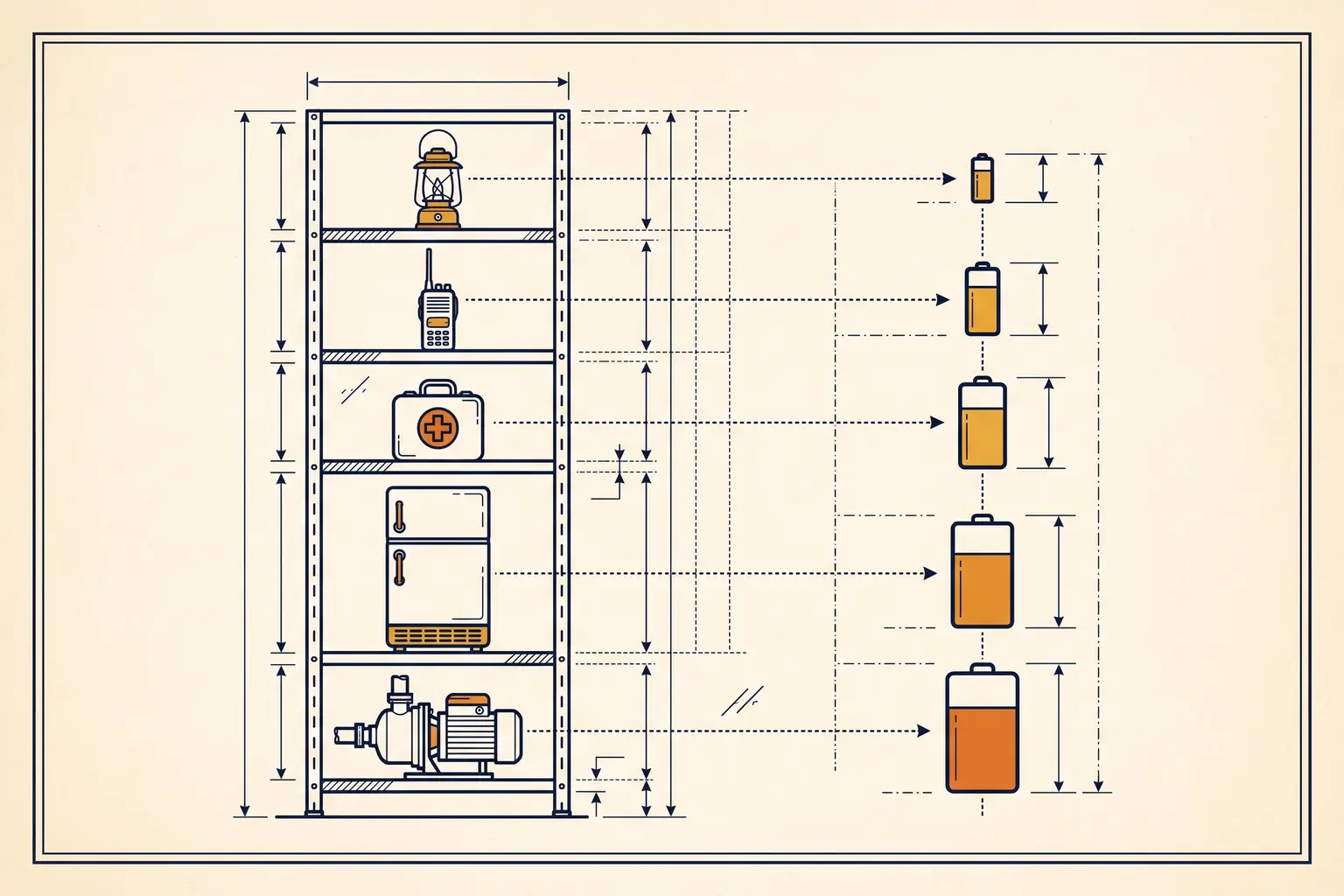
Scarce watt-hours force an order of operations. Work down this ladder — each rung must be sustainable before the next matters:
| Priority | Load | Honest daily budget | The math that decides it |
|---|---|---|---|
| 1 | Lighting (LED) | 15–25Wh | 3–5W per headlamp × 4–6 hours |
| 2 | Communications | ~40Wh | Phones, radios, weather alerts — full budget here |
| 3 | Medical devices | 240–700Wh/night | CPAP runs 30–60W; a humidifier doubles it — this jumps the queue if it applies to you |
| 4 | Refrigeration | 700–1,100Wh | An ENERGY STAR chest freezer draws 0.7–1.1kWh/day; a 100Ah 12V LiFePO4 (~1,280Wh) runs one about a day |
| 5 | Water | varies | Most deep-well pumps need 240V — the voltage problem explained; plan a 120V jet-pump alternative or stored water first |
The pattern: the ladder is cheap at the top and expensive at the bottom. Tiers 1–2 together cost about 60Wh/day — one 100W panel harvests 6–8× that on an average day. Tier 4 is where budgets get serious.
The three build tiers
Planning math: harvest/day ≈ panel watts × peak-sun-hours (4 is a common planning figure; check your region’s real number). Every figure below is arithmetic, not a promise — sun varies.
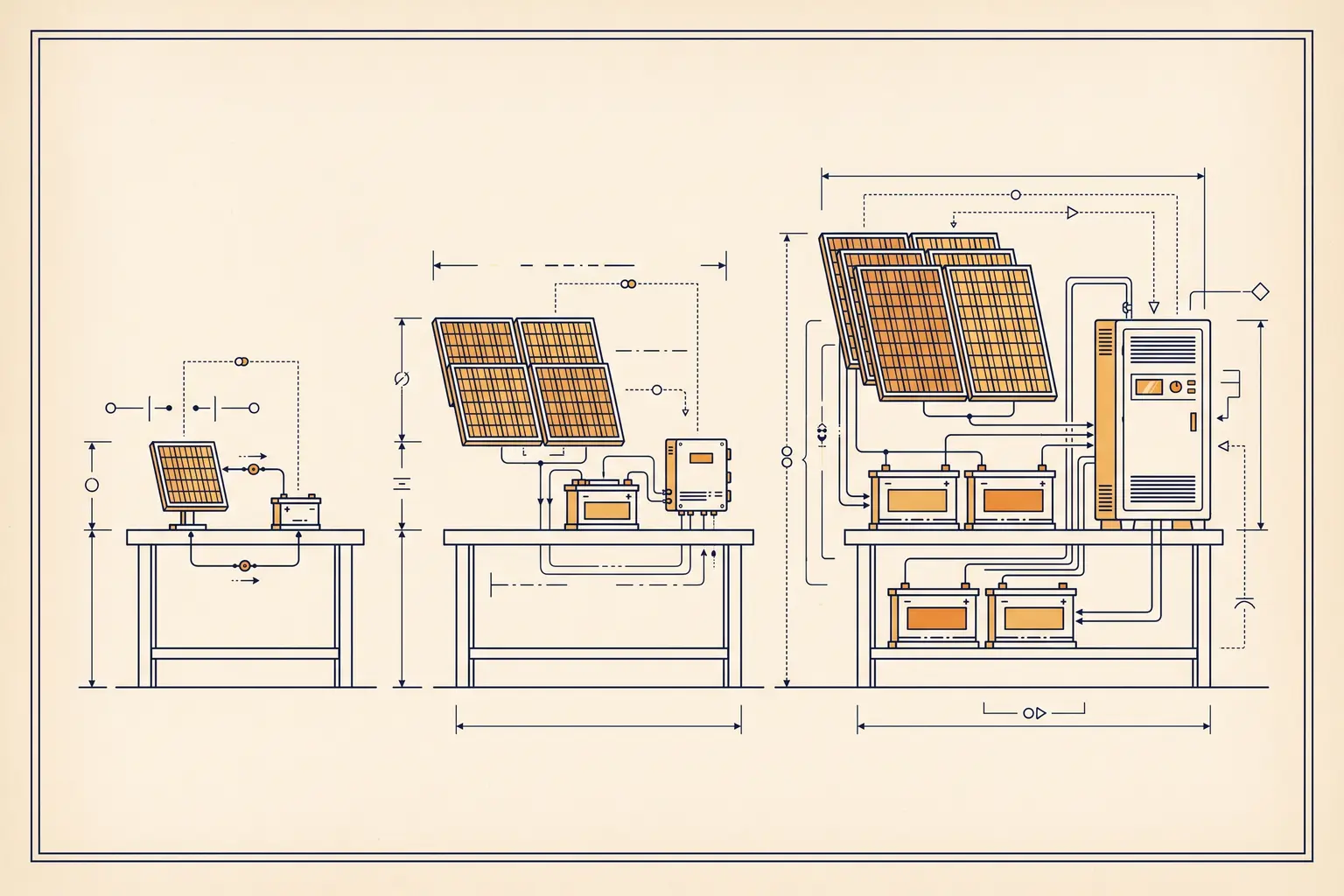
Tier 1 — The essentials kit (~US$100–180). One 100W panel, a small 20–30A controller, a modest battery (even a 35–50Ah AGM), and a multimeter. Harvest: ~400Wh/day. Runs the entire top of the triage ladder forever. Bundled 100W starter kits (panel + controller) usually cost less than the parts separately — and choosing your system voltage first keeps later expansion cheap.
Rebuilding power is measuring power: battery voltage before you connect, panel open-circuit voltage before you trust it, and current draw before you commit storage. A 600V CAT III rating covers hobby-scale DC safely (per manufacturer spec). Not for: mains or high-voltage string work. The honest tradeoff: manual ranging means you set the scale — which is also why it survives a tool bag that nothing digital should.
Tier 2 — The household essentials (~US$900–1,300). 400W of panel, a 100V/30A-class MPPT controller (~400W array ceiling on a 12V bank, per manufacturer spec), a 12V 100Ah LiFePO4 bank (~1,280Wh), and a small pure-sine inverter sized to your single biggest load — sizing method here. Harvest: ~1.6kWh/day. Covers lights, comms, refrigeration-by-day, and tool charging with margin. Wire it per the array guide.
The 100V/30A model most 300–400W builds converge on (per manufacturer spec): Bluetooth monitoring, lithium profiles, temperature compensation. Not for: arrays above ~400W on 12V — that's 150V-class territory. The honest tradeoff: you pay for the brand floor; the budget class does the same chemistry of charging for less, with a weaker track record.
Check price on Amazon (opens in a new tab) Price & availability shown on Amazon.com — we may earn a commission.Tier 3 — The household system (~US$3,500–5,000+). 800W+ of array, 200Ah+ of storage or an expandable power station class (1,024–1,152Wh units that accept extra batteries, per manufacturer specs), 240V capability if a well pump is in scope (the DELTA Pro 3 class), and proper combiner + disconnect. At this scale the full system-sizing guide takes over — the grid-down version of Tier 3 is just a well-engineered off-grid system with a hardening pass.
1,280Wh of nameplate storage, ~960Wh+ usable depth on lithium chemistry, 100A BMS. Not for: charging below freezing without the self-heating variant — [the cold-chemistry physics here](/pages/lifepo4-charging-below-freezing.html). The honest tradeoff: LiFePO4 costs more than AGM upfront and repays it in cycle life and usable depth.
Check price on Amazon (opens in a new tab) Price & availability shown on Amazon.com — we may earn a commission.Salvage versus buy
After a real disaster, new supply chains are the first thing to break and the last thing to return. The decision rule:
- Salvage first for: panels (they outlive the buildings under them), copper wire, connectors, breakers, enclosures, and structural steel. The salvage testing guide shows the two measurements that separate keepers from boat anchors.
- Buy new for: charge controllers, inverters, and battery chemistry you can’t verify. A controller that fails short takes the bank with it; a salvaged lithium battery with unknown history is a fire you haven’t met yet.
- Never improvise: the controller (unregulated charging) and the fuse (unprotected storage). Those two are where “resourceful” becomes “statistics.”
Skills beat stuff
A settlement can possess panels, batteries, and kilometers of wire and still produce nothing safe. The skills layer, in learning order: (1) measure a panel, (2) size a fuse and wire, (3) calculate a daily load budget, (4) diagnose a silent system, (5) keep a bank alive through winter. At least two people should know every critical system — knowledge concentrated in one person is a single point of failure. Learn now, while replacement parts and patient instructors still exist. Build small, measure everything, and scale what the numbers approve.