Quick answer The watt budget The charging hierarchy Muscle backup Radio choices FAQ
Quick answer
Keeping a household connected — phones, a handheld radio, weather alerts, and lighting — costs about 40Wh per day, which is one-fifth of what a single 100W panel harvests on an average day. The plan is a hierarchy, not a product: a charged power bank for day one, a small panel for day two onward, and a muscle backup (hand-crank 5–30W, pedal 50–150W) for the stretch when both are gone. Communications should be the last thing you ever ration — it is the cheapest line on the entire grid-down budget.
The communications watt budget
Every figure below is label math or physics — volts × amps × hours — rounded to planning precision:
| Device | Draw | Daily use | Daily energy |
|---|---|---|---|
| LED headlamp or lantern | 3–5W | 4–6 h | ~15–25Wh |
| Phone charge (typical battery ~4,000–5,000mAh at 3.7V) | ~15–18Wh per full charge | 1 charge | ~15Wh |
| Handheld radio (GMRS/ham), receive ~0.5W, transmit 5W | mostly receive | 8 h RX + 30 min TX | ~6Wh |
| Weather/alert radio | ~1W | 4 h | ~4Wh |
| Total — the connected household | ≈40Wh/day |
Two honest notes. First, charging inefficiency is real: expect to spend ~20–25% more than the table (cable and conversion losses), so plan 50Wh/day harvested to bank 40. Second, the loads that look like communications — laptops, TVs for news — are not in this budget. A laptop adapter draws 45–65W; one hour of that is a full day of radio. In an outage, the phone is the computer.
Medical devices jump the queue entirely: a CPAP night is 240–700Wh — bigger than the whole comms budget by an order of magnitude. If one is in the household, size for it first and read its guide, not this one.
The charging hierarchy
Layer 1 — The power bank (day one). A 20,000mAh bank at 3.7V holds ~74Wh — roughly 1.5 days of the full budget, or a week if you’re phone-only. Everyone already owns Layer 1; the plan is keeping it charged and knowing where it is.
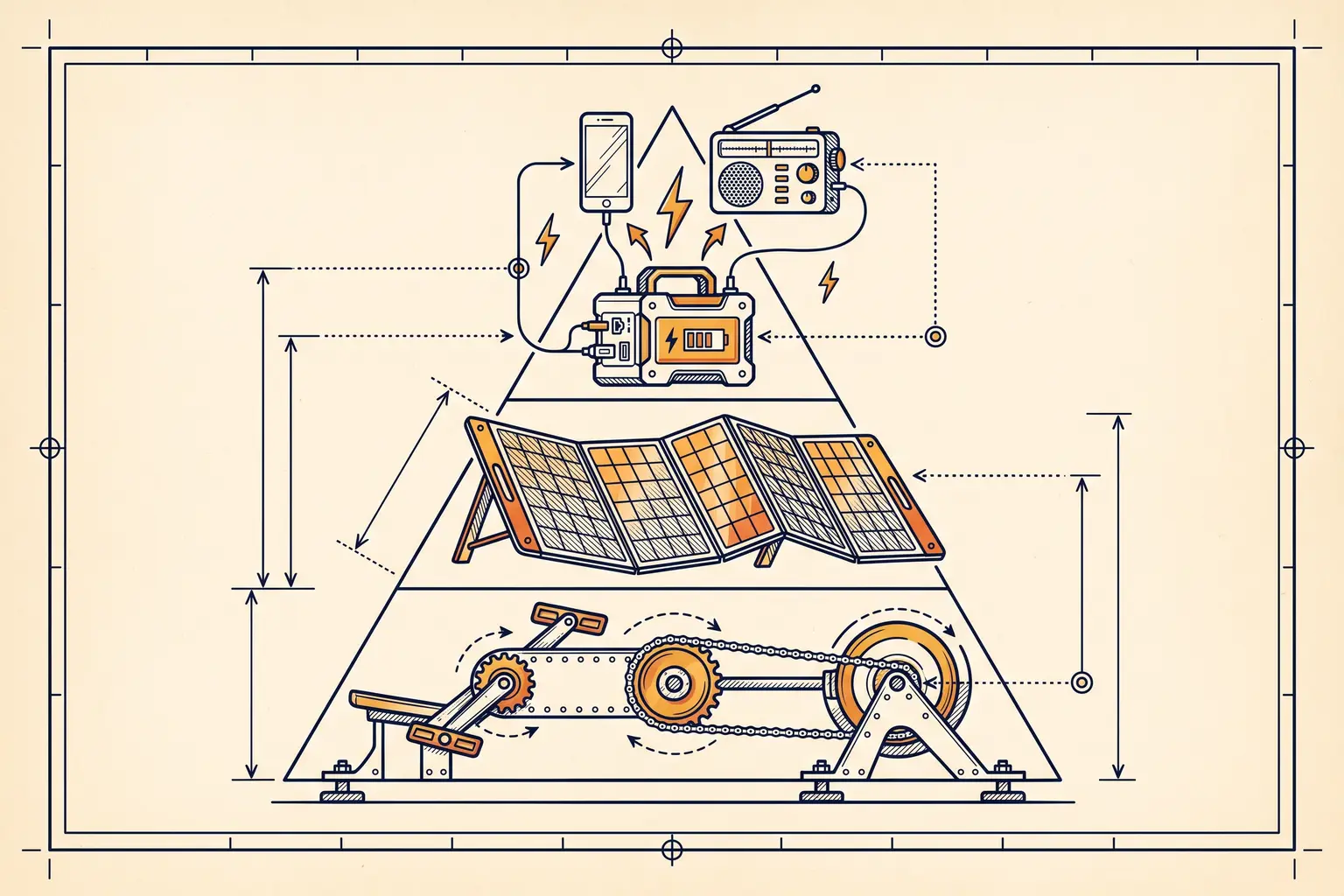
Layer 2 — The panel (day two onward). This is where the outage stops being countdown and becomes routine:
A folding 28W panel with a built-in ammeter — you watch real harvest instead of guessing (per manufacturer spec), which matters most in marginal weather. Not for: running appliances; this is a comms-and-lighting tool. The honest tradeoff: it charges USB devices directly, so it skips your 12V bank — pair it with the power bank it keeps alive.
A 28W folder in average sun delivers maybe 15–20W real — the full 40Wh budget in 2–3 hours of daylight. For the household version, a 100W panel into a proper bank makes comms effectively inexhaustible.
Layer 3 — The station (the household backbone). A 1kWh-class power station turns the comms budget trivial: 1,024–1,152Wh units run 40Wh/day for weeks, and the same station is simultaneously covering refrigeration math elsewhere in the plan. Charging it is why the array guide exists.
1,070Wh of storage and 1,500W continuous AC (per manufacturer spec) — roughly 25 days of the comms budget on one charge, while also covering lights and a freezer's daytime cycle. Not for: 240V well pumps or whole-house loads. The honest tradeoff: ~400W solar input means full recharges take good sun days; it is a buffer, not a generator.
Check price on Amazon (opens in a new tab) Price & availability shown on Amazon.com — we may earn a commission.Muscle backup: the honest numbers
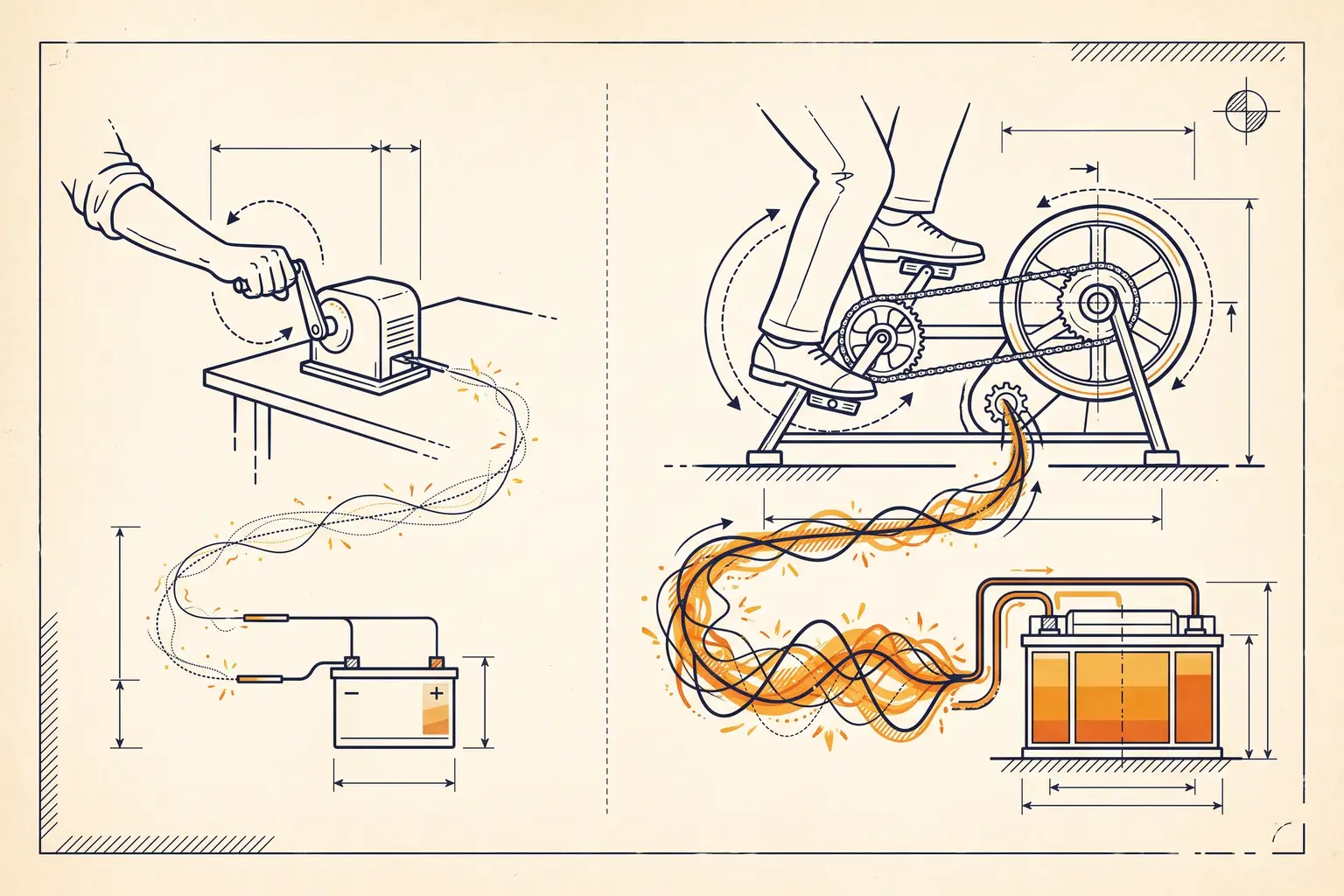
When the panel is shaded, stolen, or broken, you are the power plant — and the physics is unforgiving but usable:
- Hand-crank: 5–30W sustained. Thirty minutes of honest cranking at ~15W banks 7.5Wh — about half a phone charge. This is the hand-crank guide’s reality check: emergency watts, not house watts. Its role: the radio-and-one-phone floor that never runs out.
- Pedal power: 50–150W sustained. An hour of pedaling at a realistic 75W banks 75Wh — the entire day’s budget, twice. The pedal guide covers the build — the economics are simple: legs beat arms by 5–10× — and when the generator itself is a salvaged treadmill motor, the RPM-voltage-regulation chain is in the treadmill motor generator guide.
- Heat-to-power (TEG): a few watts. A stove-top TEG module at 3–8% efficiency trickles single-digit watts — enough to keep a weather radio alive off a woodstove you’d run anyway.
The discipline that makes muscle power work: charge a buffer (power bank), never pedal to feed a device directly. Batteries forgive your rest breaks; radios don’t.
Radios: what to standardize
Keep it to three tiers, lowest-power-first:
- Receive-only (weather/alert). Sub-watt draw, runs on AA cells a solar charger can refresh. The cheapest line on the budget — and the one that tells you when the outage ends.
- Handheld two-way (FRS/GMRS/ham). ~5W transmit, negligible receive draw. Standardize one radio type per group so batteries, antennas, and chargers interchange; label channel plans on paper.
- The phone. Highest-value, highest-draw device. Airplane mode + periodic check-ins can cut its budget by more than half — a behavioral 20Wh/day savings no hardware purchase matches.
A note on satellite messengers: genuinely useful in extended regional outages, but they add a subscription and their own charging budget — evaluate against your real risk, not your reading list.