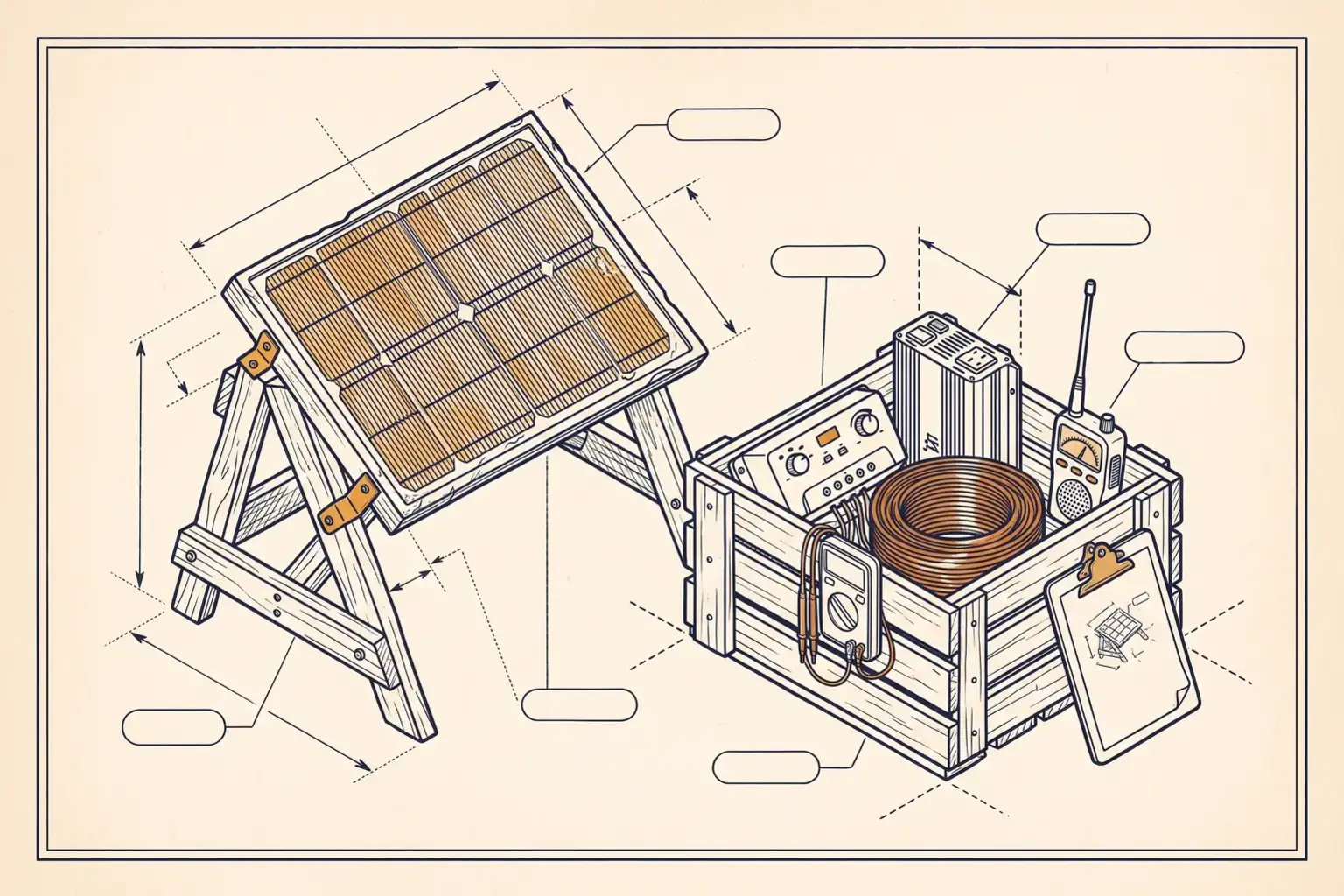
Power systems built for the day the grid can’t help you — planned with arithmetic, not adrenaline. Every article in this section leads with what the physics actually delivers, what a tested component is worth versus a pile of mystery hardware, and what to do first when watt-hours are scarce. These are engineering planning guides: we state what is established physics, what is manufacturer specification, and what we have not tested. Nothing here is survivalist theater.
Start here
- Rebuilding Power From Scratch: The Complete Grid-Down Guide — the four-element framework, a watt-budget triage ladder, and three build tiers from $100 to household scale
- Salvaged Solar Panels: Find, Test, and Use Them Safely — Voc/Isc test procedure, mismatch math, and the damage triage table before you haul anything home
Communications and load triage
- Powering Communications When the Grid Is Down — a ~40Wh/day comms budget that keeps phones, radios, and lights running, and the charging hierarchy behind it
Arrays, hardening, and repair
- From One Panel to a Microgrid: Wiring a Multi-Panel Array — string math, controller headroom rules, and a 2/4/8-panel scaling table
- Faraday Cages for Solar Electronics — what a cage can and cannot do, CME versus HEMP physics, and a falsifiable DIY attenuation test
- Solar Not Working After a Storm — the six-step diagnosis order that finds post-storm failures before you buy replacements
The generator wing
When the sun is scarce, you generate by hand, heat, and moving water — that work lives in the Project Lab: small wind, pedal power, hand-crank, TEG, and micro-hydro. The honest output math there is the same math your grid-down plan needs.